
How to Actually Run Your Business Paperwork With AI (Name → SWOT → Quote → Contract → Invoice)
· LookMood AI
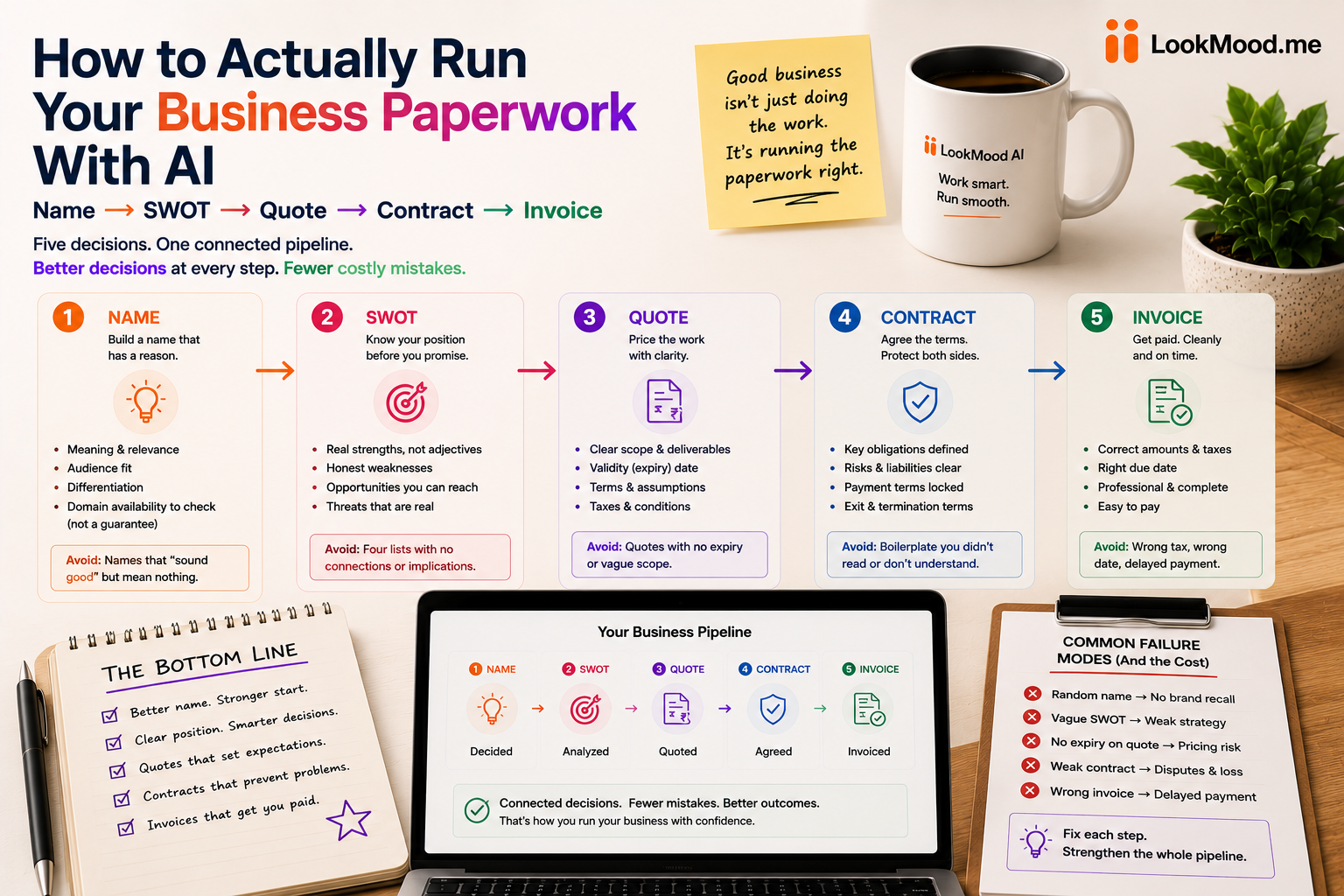
Running the paperwork side of a business isn't one task — it's five: name it, know where it stands, price the work, agree the terms, get paid. Most people solve each with a different generic tool, or skip straight to doing the work without really deciding any of them, which is how a solid business ends up with a name nobody can justify, a quote that's quietly still open six months later, and an invoice with a tax rate nobody actually agreed to.
Laid out as a pipeline, each step has a specific, common failure mode — and each one is fixable on its own.
1. The name — where "has a nice ring to it" isn't a reason
A name generator that hands you a list without saying why any option fits has given you a word, not a decision. And no generator, ours included, can actually verify domain availability in real time — a name suggestion is a suggestion to check, never a claim that it's free.
Why a business name needs a reason, not just a ring covers what a genuinely useful set of name options looks like.
2. The position — where four adjectives pretend to be analysis
"Strong team, growing market, competition, funding" is the shape of a SWOT with none of the substance. A real one is specific to your business, and connects the boxes to each other — a strength pointed at a threat is a strategy; four independent lists are just four lists.
Why most SWOT analyses are useless, and what makes one actually useful goes into what that connection actually looks like.
3. The offer — where a quote quietly becomes a liability
A quote and an invoice aren't the same document wearing different labels. An invoice has a due date because it's a bill for finished work; a quote has an expiry because it's a price that shouldn't stay open forever. Skip the expiry and you're on the hook for a price you wrote months ago.
A quote is not an invoice, and treating them the same costs you covers the difference in full.
4. The agreement — where the value isn't the summary
A shorter version of a contract you didn't read carefully is still a contract you don't fully understand. The real value is the obligation buried in section fourteen, and the clause a document like this normally has that yours doesn't — an absence a fast skim almost never catches.
What an AI contract review actually catches (it's not the summary) covers what that looks like done properly.
5. The bill — where a confident guess is worse than a blank field
An invoice with no tax line because none was mentioned is honest. An invoice with an invented tax rate is a guess wearing the outfit of a fact — the actual fix is separating the fields that are facts (client, amounts — never invent, always ask) from the fields that are boilerplate (invoice number, currency, tax when unmentioned — safe to default).
Why AI invoices get tax wrong covers that distinction end to end.
Running the whole pipeline
Each of these is a genuinely separate decision, but in practice they happen in sequence, against the same business:
- Business Name Generator — describe the business, get names in genuinely different directions, each with the reason it fits.
- SWOT Analysis Generator — get an honest read on where the business stands, grounded in what you've actually described.
- Quotation Maker — price the work with a real expiry date, so an old number can't quietly become today's obligation.
- Contract Review — once there's an agreement, know what it actually commits you to, and what it's missing.
- Invoice Generator — bill for the finished work, without a fabricated tax rate anywhere near the total.
Same agent, same conversation, the whole way through — no switching between five separate single-purpose tools and losing context between each one.
Start with the name
Every business starts as an idea before it's anything else. Begin with the Business Name Generator — free, no signup needed — and work through the pipeline from there.