
A Quote Is Not an Invoice (And Treating Them the Same Costs You)
· LookMood AI
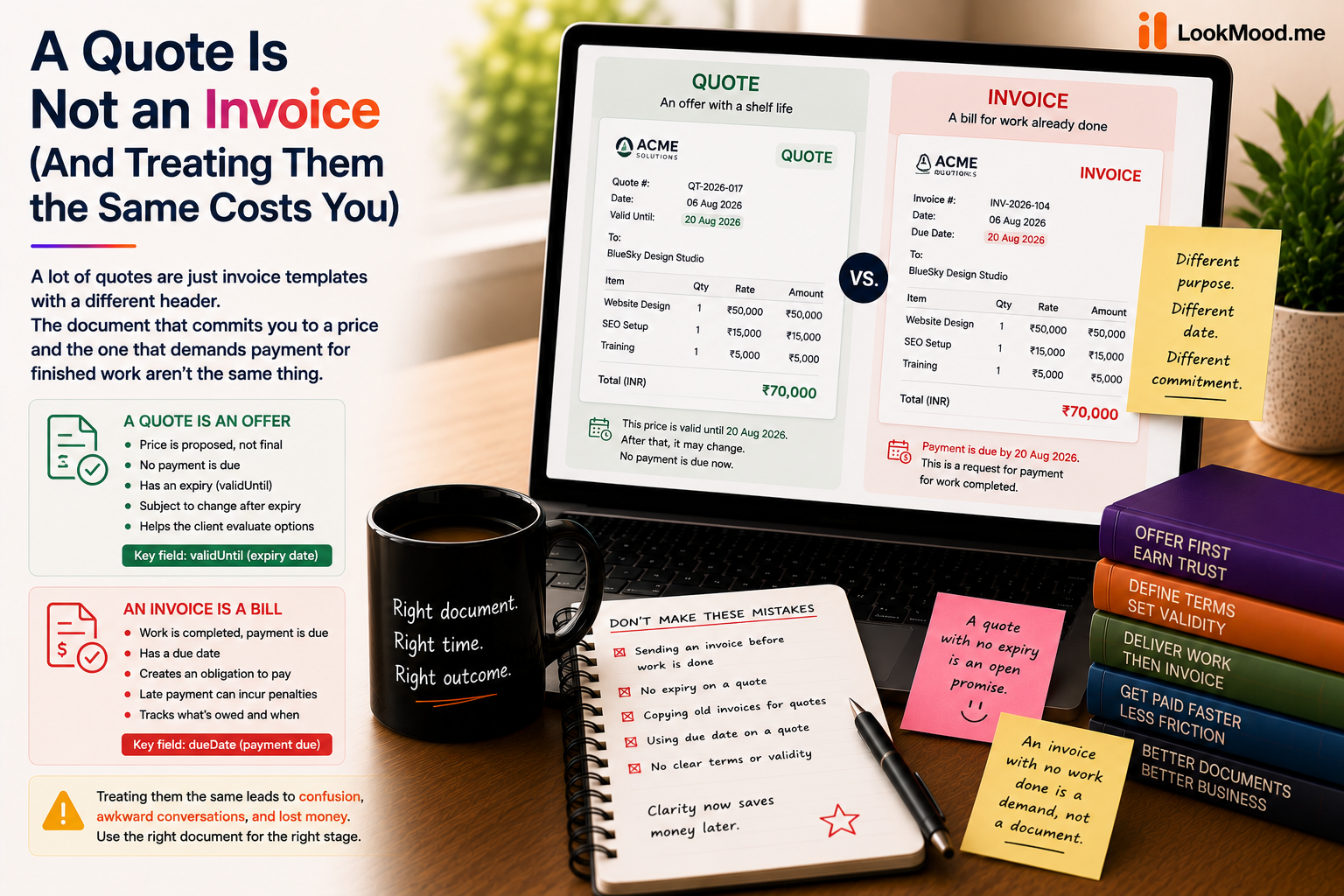
A lot of people build a quote by taking an old invoice, swapping the header, and sending it. The layout looks fine. The problem is underneath — a quote and an invoice commit you to two genuinely different things, and the document that only changes its title doesn't know which one it's making.
The real difference is a date field, not a label
An invoice has a due date — it's a claim for money owed on work already delivered, and the due date says when payment is expected. A quote has an expiry — validUntil — and it says something completely different: this price holds until this date, after which I'm not bound to it. One is a bill. The other is an offer with a shelf life.
Confuse the two and you get one of two bad outcomes. Send something that reads like an invoice before any work has happened, and you've sent what looks like a demand for money for a job you haven't started — which reads as presumptuous at best. Send a quote with no real expiry, and you've made an offer that's technically open forever, at whatever price you happened to write down the day you sent it.
A quote with no expiry is a quiet liability
This is the part that costs actual money. Materials go up. Your rate changes. Six months after you sent a quote with no expiry date, it's still sitting in someone's inbox at the old number — and if they accept it, you're the one who has to decide whether to honor a price you'd never quote today, or have the awkward conversation explaining why you won't. A validity date isn't paperwork formality. It's the thing that stops an old number from becoming today's obligation.
Everything else about a quote is a fact, not boilerplate
The client's name and the amounts are facts — they have to come from you, and a tool that invents either one is producing a document that misrepresents a deal that was never actually offered. The quote number and the issue date are boilerplate — safe to fill in automatically, because they don't change what's actually being offered to whom. The validity date sits closer to the facts side than people usually treat it: it's not decoration, it's the one piece of boilerplate that actually protects you.
What this looks like done properly
LookMood AI's Quotation Maker never invents the client or the amounts — if either is missing, it asks instead of guessing — and it defaults a real validity window rather than leaving your price open indefinitely. It downloads as a real PDF, ready to send. Free, no signup needed.
Once a client accepts a quote and things move toward a signed agreement, what matters next is what that agreement actually commits you to — what an AI contract review actually catches (it's not the summary) picks up from there.