
What an AI Contract Review Actually Catches (It's Not the Summary)
· LookMood AI
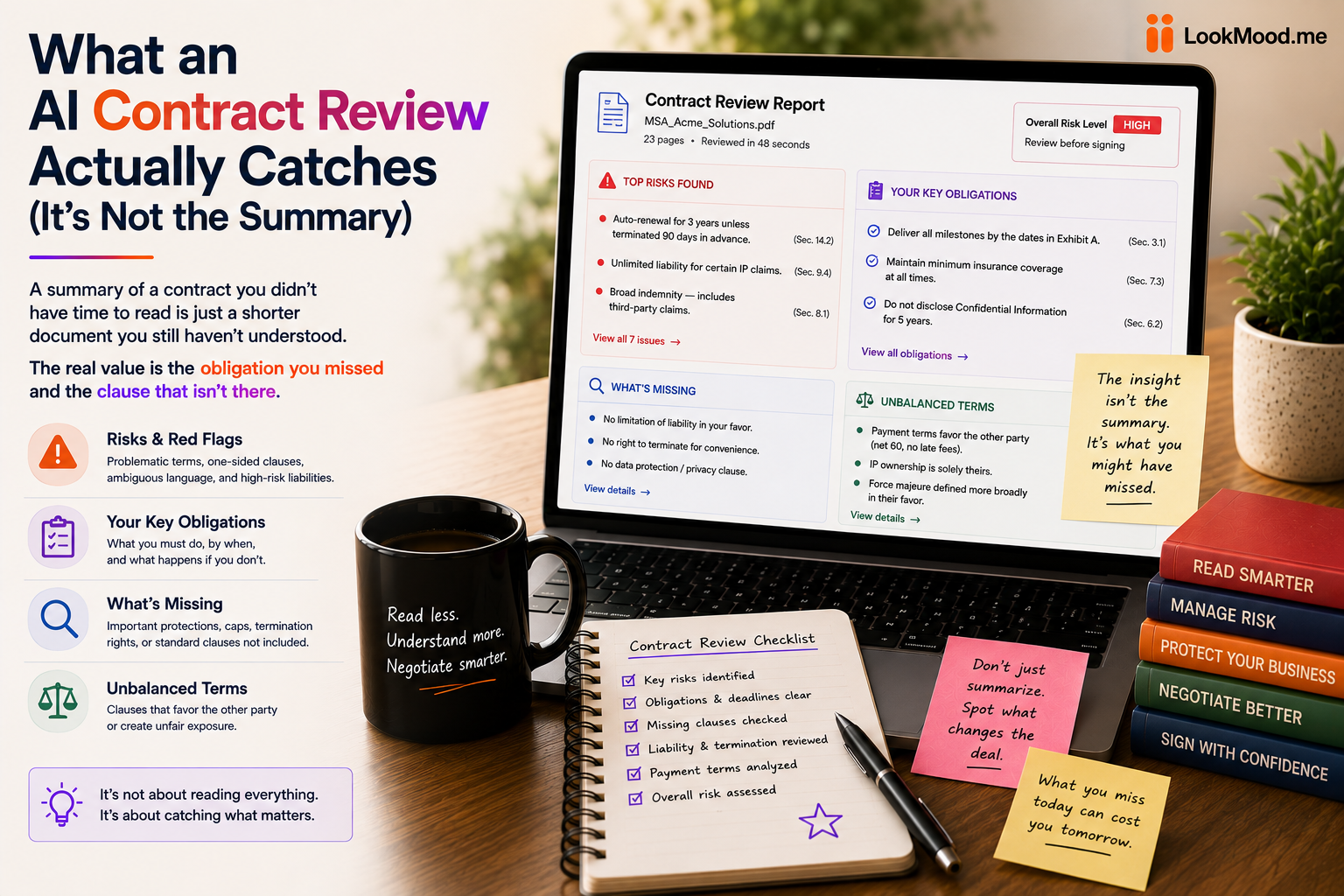
Ask most people what they want from an AI contract review and they'll say a summary. But a summary of a contract you didn't have time to read properly is just a shorter version of a document you still don't fully understand. It's not useless — it's just not the part that's actually worth the trip.
The value is the obligation you missed, not the paraphrase
Contracts bury the parts that matter. A termination clause with unusual notice terms sits in section fourteen, not the introduction. An obligation you didn't realize you'd taken on — a specific deliverable timeline, an exclusivity term, a cap on liability that only favors the other side — reads like routine boilerplate unless someone actually pulls it out and states it plainly. A summary tells you what the document is broadly about. What you actually need is what it specifically commits you to, restated in language you'd immediately understand.
The strongest signal is what's not there
Here's the part a quick read genuinely can't catch: an absence. A person skimming a contract notices what's written. They almost never notice what a document of this type would normally include and doesn't — no termination clause, no confidentiality obligation, no clause covering what happens if a payment is late. Missing clauses aren't visible the way a bad clause is visible; there's nothing on the page to catch your eye. Spotting an absence means already knowing what should be there and checking for it specifically — which is exactly the kind of systematic comparison a careful read is built for, and a fast skim isn't.
Risk without invented drama
The honest version of this only flags a risk that's actually grounded in the document in front of it — a specific one-sided clause, a real gap, not generic contract advice that would apply to any agreement of this type whether or not it's actually a problem here. Parties, obligations, and risks all come from what's genuinely written or genuinely missing — never a clause invented to make the review look more thorough than the document warrants.
It's the same discipline a good meeting summarizer applies to who owns an action item — a blank field because something genuinely isn't there is more honest, and more useful, than a confident answer that was never actually in the source.
What this looks like done properly
LookMood AI's Contract Review reads the actual document — pasted or uploaded — and returns the terms that matter, the obligations you're actually agreeing to, real risks graded by severity, and the clauses a document of this type typically has that this one doesn't. Free, no signup needed.
Once the agreement holds up and the work is delivered, the paperwork on your side is the invoice — and why AI invoices get tax wrong covers the one place that document quietly goes wrong too.