
Why AI Invoices Get Tax Wrong
· LookMood AI
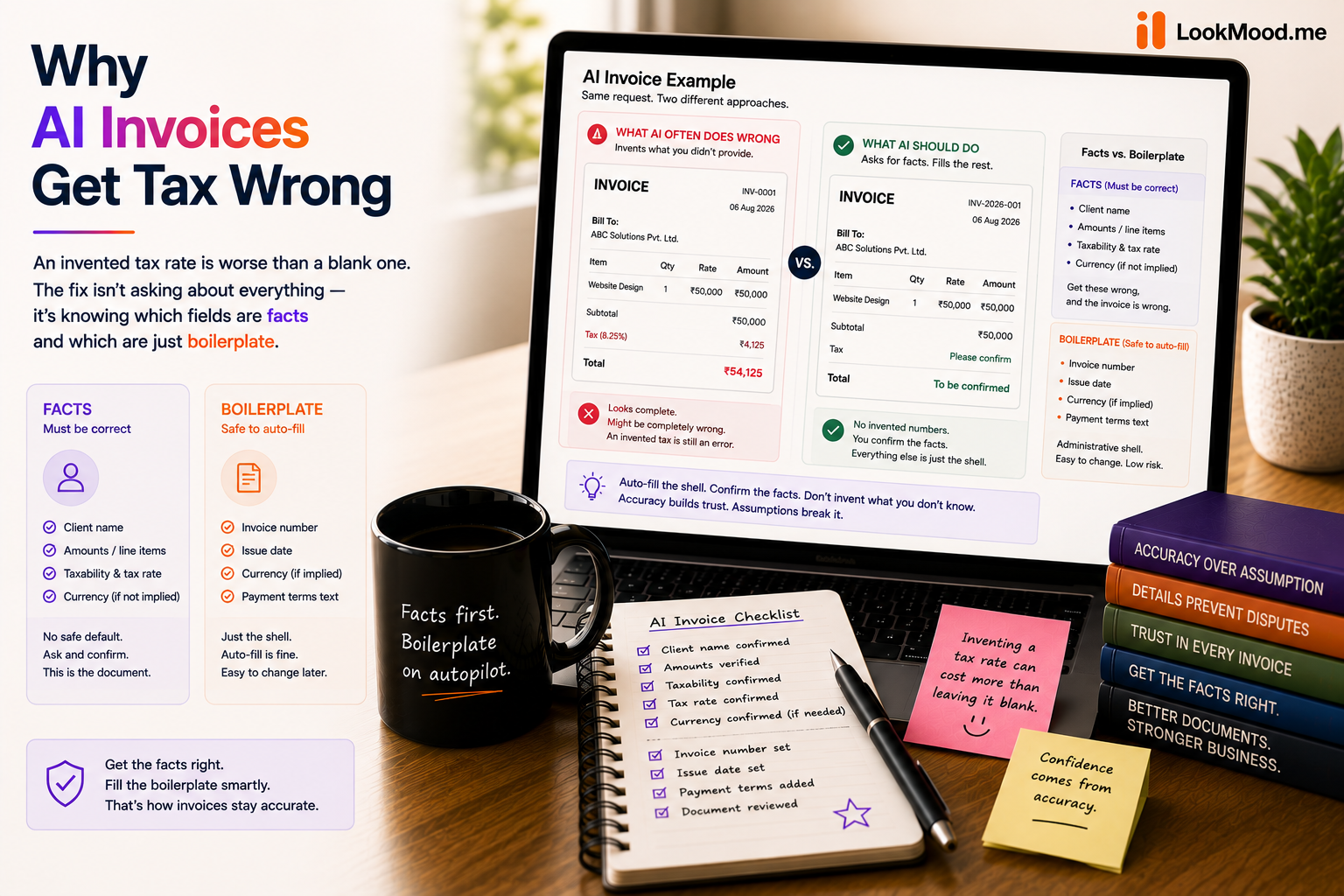
Ask most AI tools for an invoice and you'll get one back in seconds — clean layout, line items, a tax line, a total. It looks finished. Somewhere in there is a tax rate you never specified, filled in because a blank field looks incomplete and looking complete is what these tools optimize for. You'd catch a tax rate of 90%. You won't catch 8.25% when it should have been zero.
The real distinction isn't "always ask"
The obvious-sounding fix — make the tool ask about everything it isn't sure of — is wrong too. Stopping a user mid-invoice to demand a sequential invoice number, an issue date, or a currency before it'll produce anything is worse UX for close to zero benefit. The actual fix is knowing which fields are facts and which are boilerplate, and treating each one differently.
Facts are the client's name and the amounts — what you're owed, and by whom. Get either wrong and the document is wrong at the level that matters; there's no safe default for a client you didn't name or a price you didn't state, so the only honest move is to ask. Boilerplate is the invoice number, the issue date, the currency when none was implied — the administrative scaffolding around the facts, not the facts themselves. Auto-filling "INV-0001" or defaulting to USD doesn't misstate anything about the transaction. It just fills in the shell, and you can fix a mismatched invoice number in two seconds — you can't un-invent a client's identity you never actually confirmed.
Where the line actually gets crossed
Tax sits right on that boundary, which is why it's where things go wrong. A tool that leaves tax at zero when you never mentioned it isn't guessing — it's accurately reflecting that you didn't say anything about tax. That's boilerplate treatment, and it's honest. A tool that invents a rate — 8.25%, VAT at 20%, whatever sounds plausible for the format — has quietly turned a fact into a guess and presented it with the same confidence as the client's name. That's the actual failure. Not the absence of a tax line. The invention of one.
A blank tax line is information
An invoice with no tax line tells you something true: no tax was specified in this transaction, and it's on you to check whether your situation requires one — sales tax, VAT, and GST all depend on where you're registered and what you actually sold, not on what an invoice template happens to default to. A wrong tax rate tells you something false, confidently, and it's the kind of wrong you don't catch until a client's bookkeeper queries it or you realize you undercharged and now have to go back and ask for money for work already delivered. It's the same principle a good PDF summarizer applies to page citations and a good meeting summarizer applies to who owns a task — a blank field because something genuinely wasn't specified beats a confident field that was never actually true.
What this looks like done properly
LookMood AI's Invoice Generator never invents a client, a line item, or a tax rate — if a fact is missing, it asks. It auto-fills the boilerplate that doesn't change what's owed or by whom, so you're not stuck typing your own invoice number before you can get a document. It downloads as a real PDF, ready to send. Free, no signup needed.
Invoice is the last document in the chain — if you want to see how naming, positioning, quoting, and contracts all lead here, the full pipeline is laid out in one place.