
Why Most SWOT Analyses Are Useless (And What Makes One Actually Useful)
· LookMood AI
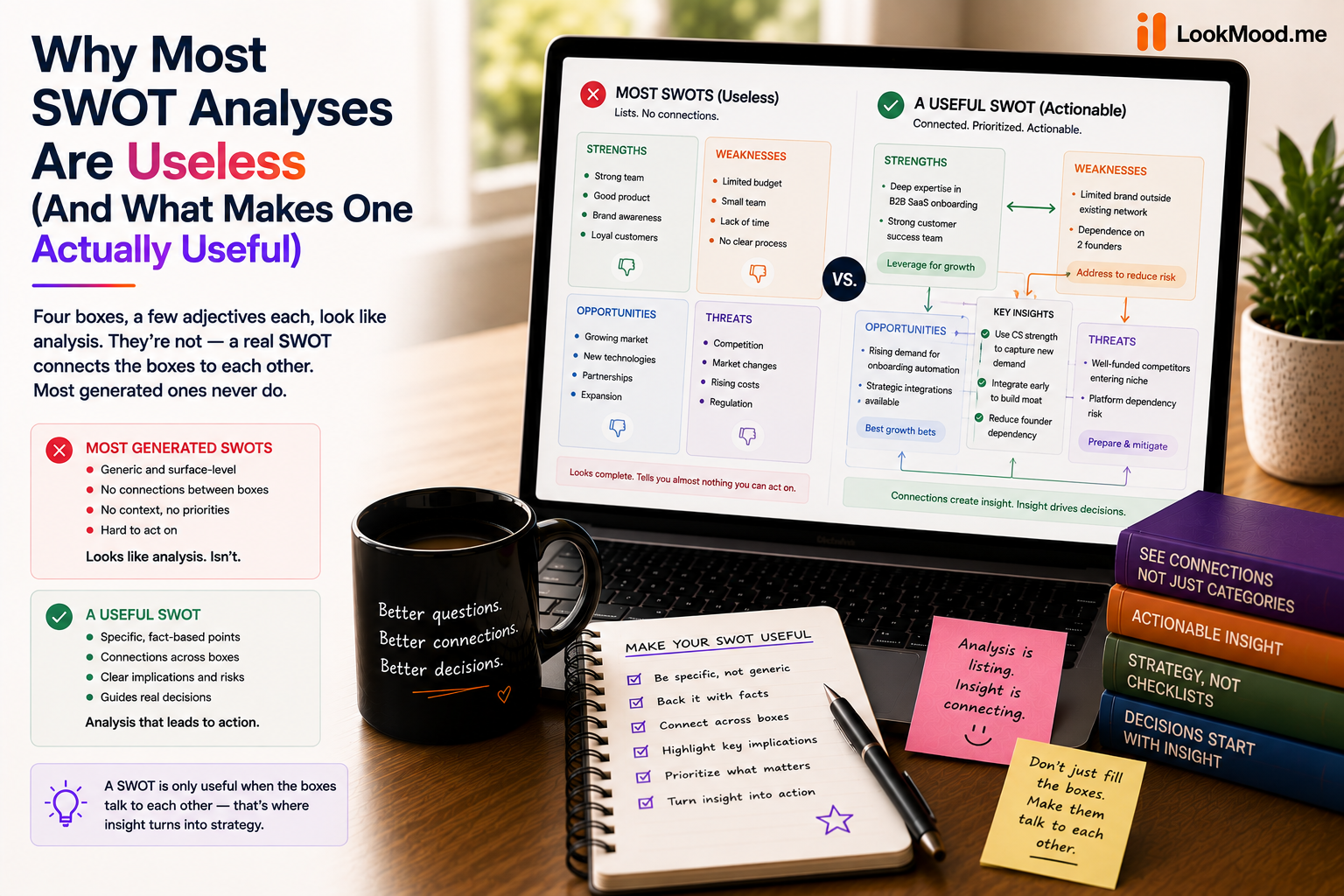
Four boxes, a handful of bullets in each — "strong team," "growing market," "competition," "funding" — and it looks exactly like the SWOT analysis you were taught to make. It also tells you almost nothing you could act on tomorrow morning.
The format is right. What's usually missing is the actual analysis part — the reason a SWOT is worth doing at all instead of just listing four kinds of thoughts you already had.
Adjectives aren't analysis
"Strong team" is a compliment, not a strength you can use. What made it a strength — deep experience in a specific channel, an existing relationship with the exact customers you're targeting, someone who's shipped this before and knows where it usually breaks — is the part that actually informs a decision. A generic label describes nothing that would change if you swapped it into a completely different business.
The quadrants are supposed to talk to each other
This is the part almost every quick SWOT skips entirely: the four boxes aren't four independent lists, they're meant to be read against each other. A strength only becomes strategy when it's pointed at a specific threat or opportunity — "our existing customer relationships" is a strength on its own, but it's a strategy once it's connected to "a competitor is about to enter this market," because now you know exactly what to lean on and why.
A weakness that blocks a specific opportunity is worth flagging loudly; a weakness that doesn't touch anything else on the page might not matter much right now. None of that shows up if the four boxes are just filled independently and left there — which is exactly what a tool optimizing for "four lists, done" will produce, and exactly what a strategic note connecting them is supposed to fix.
Specific to your business, not generic to the category
The other failure mode is a SWOT that would apply to almost any business in your general space — "increasing competition" as a threat, "market growth" as an opportunity — true of thousands of companies and useful to none of them specifically. The only inputs worth including are the ones grounded in what you actually described. Reasonable inference from what you've said is fine; a specific competitor, a market-share number, or funding data you never mentioned is not analysis, it's invention dressed up as research.
What this looks like done properly
LookMood AI's SWOT Analysis Generator works from what you've actually told it — no invented competitors, no fabricated market data — and closes with a strategic note that's specific to your situation, not a generic line that could sit on top of any SWOT. It's free, no signup needed.
Once you know where the business actually stands, the next real decision is what you charge for the work — why a quote is not an invoice, and why treating them the same costs you picks up from there.