
Why an AI Mood Journal Might Be the Habit You Actually Stick To
· LookMood AI
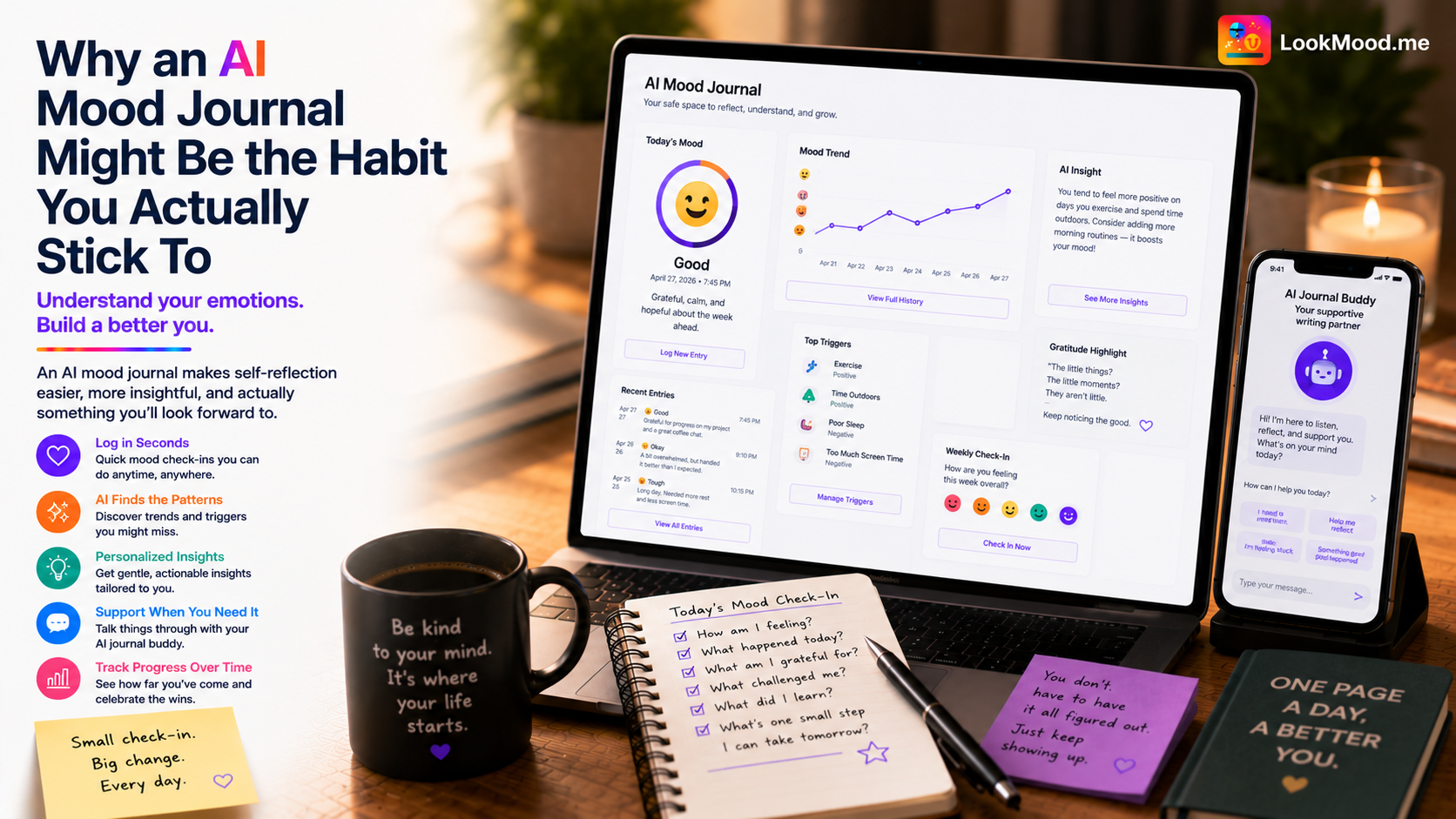
You've started journaling four times. First attempt lasted six days. Second time, three. Third time you wrote one really good entry and then forgot about it for two weeks. Fourth time, you opened the notebook, stared at a blank page, couldn't think of what to write, and closed it.
The blank page is the problem. Traditional journaling puts all the structure on you — you decide what to write about, how much to say, when to stop. For people who find that energizing, journaling is a great habit. For everyone else, it's a guilt-inducing blank page that gets abandoned.
An AI mood journal removes the blank page problem entirely.
How AI journaling is different
Instead of writing to a blank page, you write to something that responds. The AI asks follow-up questions, reflects things back, and gives you somewhere to go when you don't know where to start.
"I'm feeling off today" — in a traditional journal, that might be where you stop, because you don't know how to develop the thought. In an AI journal, that sentence becomes a starting point: what kind of off? Is it a mood thing or a physical thing? Did something specific happen or has it been building? The AI doesn't know the answer, but asking the question moves the session forward.
This makes the habit significantly more forgiving. You don't need to have something profound to say. You don't need to write a certain amount. You can check in with three sentences and come away with more clarity than you walked in with.
A worked example
Here's what a session with LookMood AI's mood journal might look like:
"I've been weirdly irritable all day and I don't know why. Nothing bad happened."
A good AI response doesn't immediately try to problem-solve or pathologize. It asks a calibrating question: is the irritability more directed (at a person, a situation) or more diffuse (just background static)? That question alone often helps — naming the texture of a mood is the first step to understanding it.
You might say: "Diffuse, I think. Just kind of flat and short-tempered." From there, useful follow-ups: How's your sleep been? Has this week been higher-pressure than usual without obvious stress? Sometimes the AI will reflect a pattern back — "You mentioned something similar about three weeks ago on a Monday — could there be a weekly rhythm here?"
That's the session. Five minutes. No blank page. More clarity than you started with.
The long-term benefit
Where the AI mood journal becomes genuinely interesting is over weeks and months. You build a record. Not a diary of events, but a log of emotional states with enough context to spot patterns.
You might notice that your low-energy periods consistently follow weeks of overcommitment. Or that your best weeks tend to start with certain types of Sunday. Or that a particular type of work stresses you more than you consciously acknowledge. These patterns are almost impossible to see in real time. They become visible with a record.
The habit doesn't need to be daily to be useful. Even three times a week, consistently, over two months, gives you more insight into your emotional patterns than most people get in years of introspection. The consistency matters more than the frequency.
For related daily check-in habits, see how to analyze any meal with AI — another low-friction awareness practice. And how to do a vibe check on any situation using AI covers a similar read-what's-happening use case for external situations.