
How to Analyze Any Meal With AI: Nutrition, Ingredients, and More
· LookMood AI
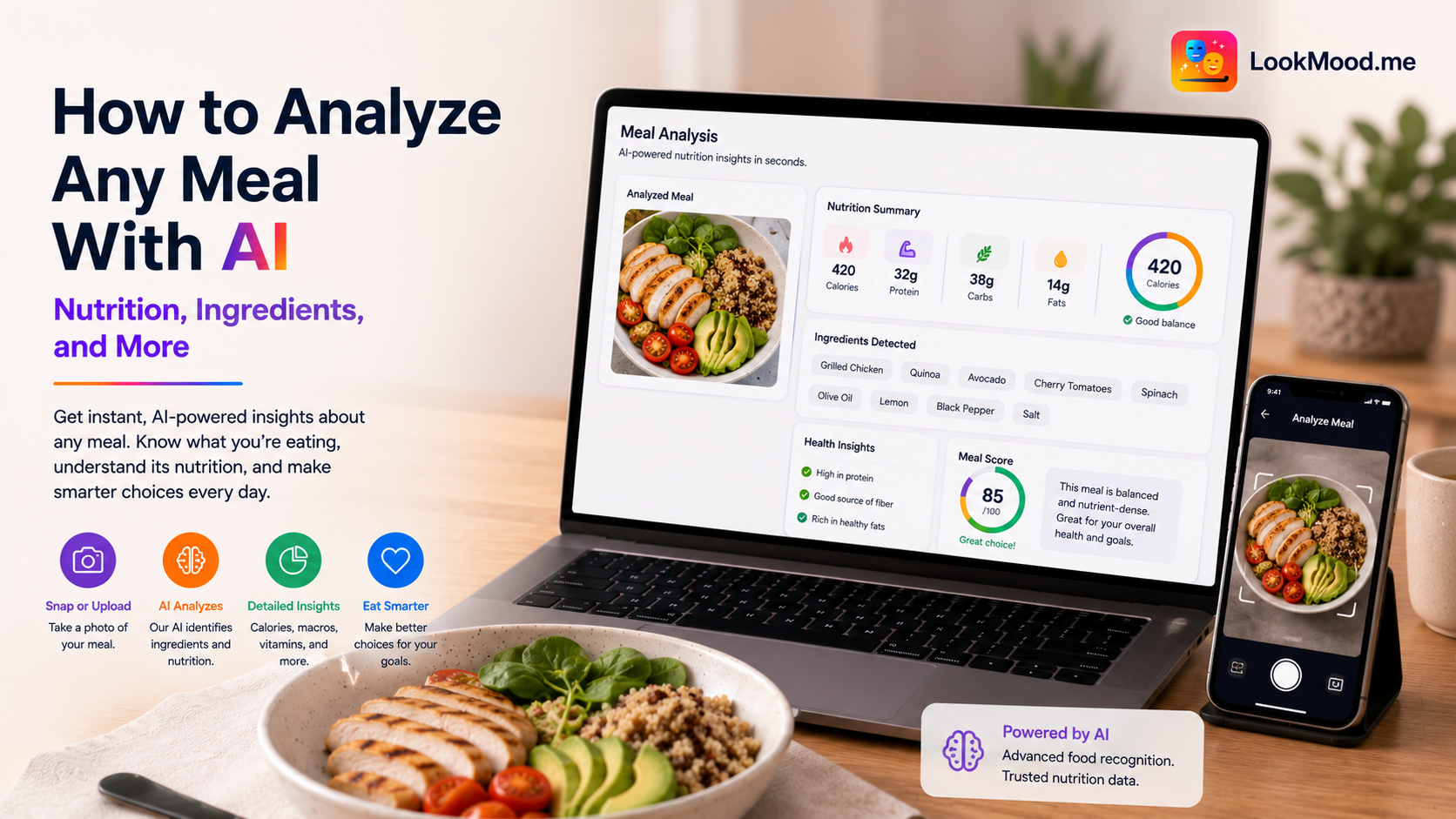
You're looking at a plate of food and wondering what's actually on it. Not because you're in crisis mode about calories — just because you're curious, or you're trying to eat differently, or you ordered something unfamiliar and want to understand it. You don't have a barcode to scan. You don't have a food database entry. You just have the plate.
This is exactly the gap most food apps don't fill well. They're designed for packaged food with scannable labels, or for home cooking where you're entering every ingredient. For real food in the real world — restaurant meals, dishes someone else cooked, street food, buffets — the traditional tracking tools fall apart.
What AI food analysis actually does
AI can analyze food from a description, a photograph, or both. It reasons about what's likely in a dish based on cuisine type, cooking method, typical portion size, and visible ingredients — not from a database lookup, but from reasoning about the dish as it actually appears.
This is useful for:
- Identifying what's in a dish. You ordered something at a restaurant and aren't sure of all the ingredients — relevant if you have allergies or dietary restrictions.
- Rough nutritional estimation. Not a precise calorie count, but a useful ballpark for protein, carbohydrate, and fat balance when making decisions about what to eat.
- Understanding cooking methods. Whether something was fried, steamed, roasted, or sauteed significantly affects its nutritional profile in ways that aren't obvious from looking at the final dish.
- Getting substitution suggestions. If an ingredient doesn't work for you, AI can suggest what it does in the dish and what would replace it without wrecking the result.
A worked example
Here's a specific prompt for LookMood AI's food analyzer:
"I just ate at a Thai restaurant. I had a bowl of pad see ew with chicken — medium portion, restaurant-sized. Estimate the macros and tell me anything I should know about what's in it if I'm trying to keep protein up and manage refined carbs."
A good response gives you a realistic estimate (pad see ew is wide rice noodles with egg, protein, and vegetables in a light soy and oyster sauce — a medium restaurant portion is roughly 600–750 calories, with protein depending heavily on the chicken portion given), notes the carbohydrate source (flat rice noodles are high glycemic index), and gives practical context without moralizing about the food. If you want to increase protein relative to carbs next time, it'll tell you what modification to request.
The key advantage over a calorie app: the AI gives you context and reasoning, not just numbers. You understand why the numbers are what they are, which makes the information actually useful rather than just anxiety-inducing.
What AI food analysis is and isn't
It's not a medical nutrition tool. If you have a condition that requires precise tracking — diabetes management, specific clinical dietary needs — you need a registered dietitian and precise tools, not AI estimates.
For everything else: the curious eater who wants to understand food better, the person making gradual dietary changes without obsessive tracking, the traveler eating unfamiliar cuisines — AI food analysis is one of the more practically useful tools available. It works on the food that's actually in front of you, not just the food that comes in a labeled box.
For other daily habit uses, see why an AI mood journal might be the habit you actually stick to — a different kind of daily check-in. And for a similar visual-analysis use case, how to use AI to rate your outfit covers what AI sees in visual input.