
How to Use AI to Rate Your Outfit Before You Leave the House
· LookMood AI
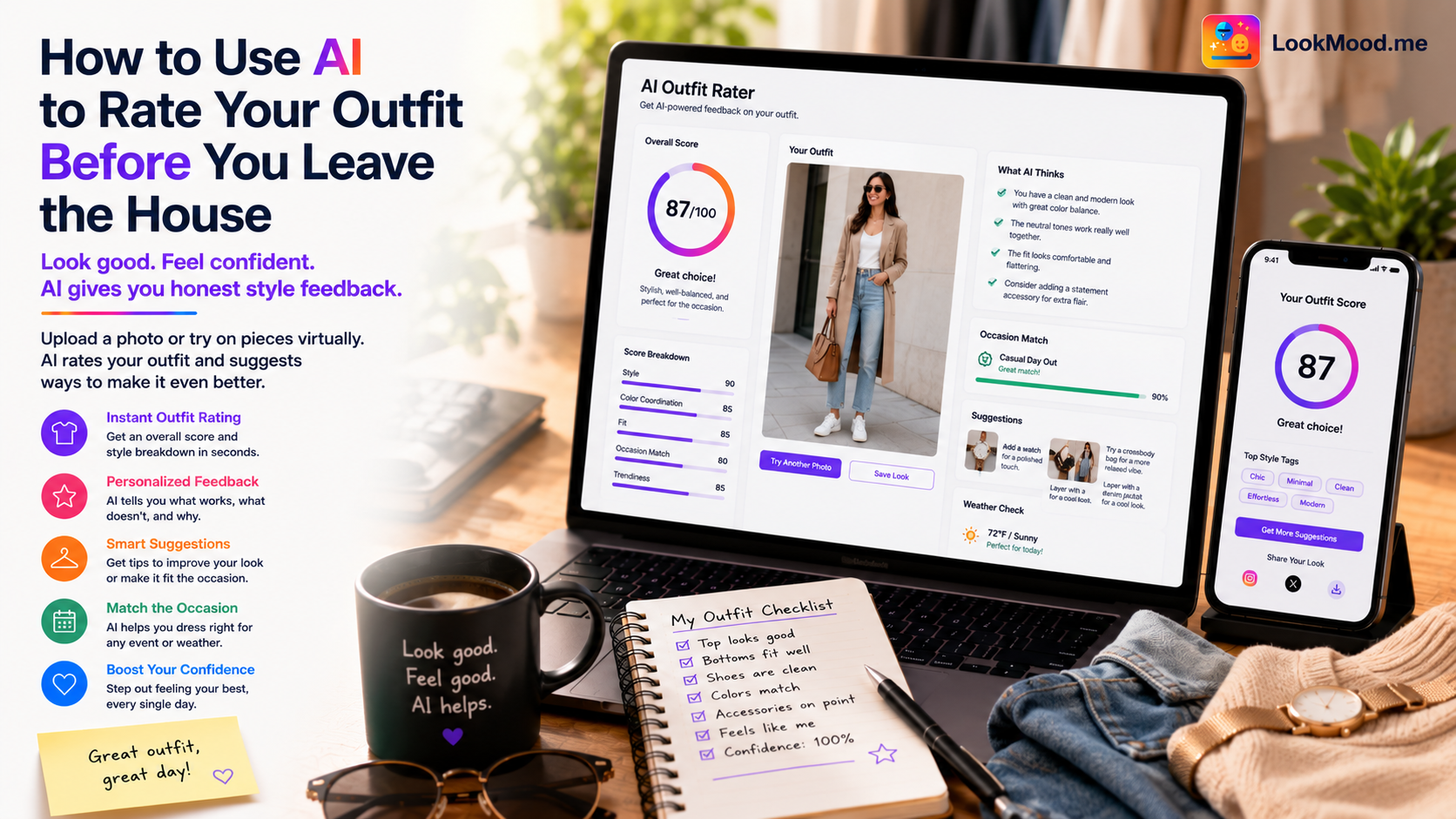
You've been standing in front of the mirror for eight minutes. The outfit feels right. You think. The longer you look, the less certain you are. You're leaving in five minutes and you've now second-guessed three separate elements of the look.
The outfit problem is primarily a feedback problem. When you're getting dressed alone, you have no external perspective. Your brain fills the gap with either overconfidence or doubt, neither of which is particularly calibrated. A second opinion — even an artificial one — gives you something to work with.
What an AI outfit rater actually looks at
The useful AI outfit feedback isn't "that looks great" or "that doesn't work." It's specific observations about what's happening and why.
Good AI outfit analysis considers:
- Proportion and silhouette. Is the volume balanced across the outfit? Oversized on top and fitted on the bottom versus the reverse creates very different effects.
- Color coordination. Not just whether colors go together, but the temperature and saturation balance — warm neutrals with cool accents, or all warm, or all cool.
- Occasion fit. The same outfit reads completely differently at a casual Friday meeting versus a client dinner. Context matters as much as aesthetics.
- One element standing out in the wrong way. Often there's one piece — a shoe, a bag, a layer — that's pulling the look in a different direction from everything else.
A worked example
Here's a specific prompt for LookMood AI's outfit rater:
"I'm wearing: wide-leg dark navy trousers, a fitted white cotton shirt tucked in, tan leather loafers, and a burgundy blazer. I'm going to a daytime work presentation with external clients — semi-formal. Rate the outfit and tell me specifically if anything is off."
A good response addresses the outfit as a complete system rather than individual pieces. In this case it might note that the combination works well for the occasion (the navy and white base is clean and authoritative, the tan shoe grounds the look), but flag whether the burgundy reads as accent or contrast depending on the specific shade — a muted wine burgundy works; a bright magenta-burgundy would compete with the navy. It might also suggest that whether the shirt is fully tucked or half-tucked changes the overall formality read, which matters for client context.
That's the kind of specific, actionable feedback you'd get from someone who thinks about clothes. It's more useful than "looks professional" or "nice outfit."
When it's most useful
The outfit rater is most valuable in a few specific situations:
- High-stakes events where you want to get it right (interviews, presentations, first dates)
- When you're wearing something new and aren't sure how the pieces work together
- When you're in a new context — new city, new job, new social group — and you're calibrating what's appropriate
- When you've lost perspective from looking too long
For everyday dressing, you probably don't need a second opinion. For the days when you do, having one immediately available is a meaningful convenience.
If you're curious about AI for other visual analysis tasks, see how to analyze any meal with AI for a similar use case in a different context. And how to do a vibe check on any situation using AI covers the broader read-the-room use case.