
How to Do a Vibe Check on Any Situation Using AI
· LookMood AI
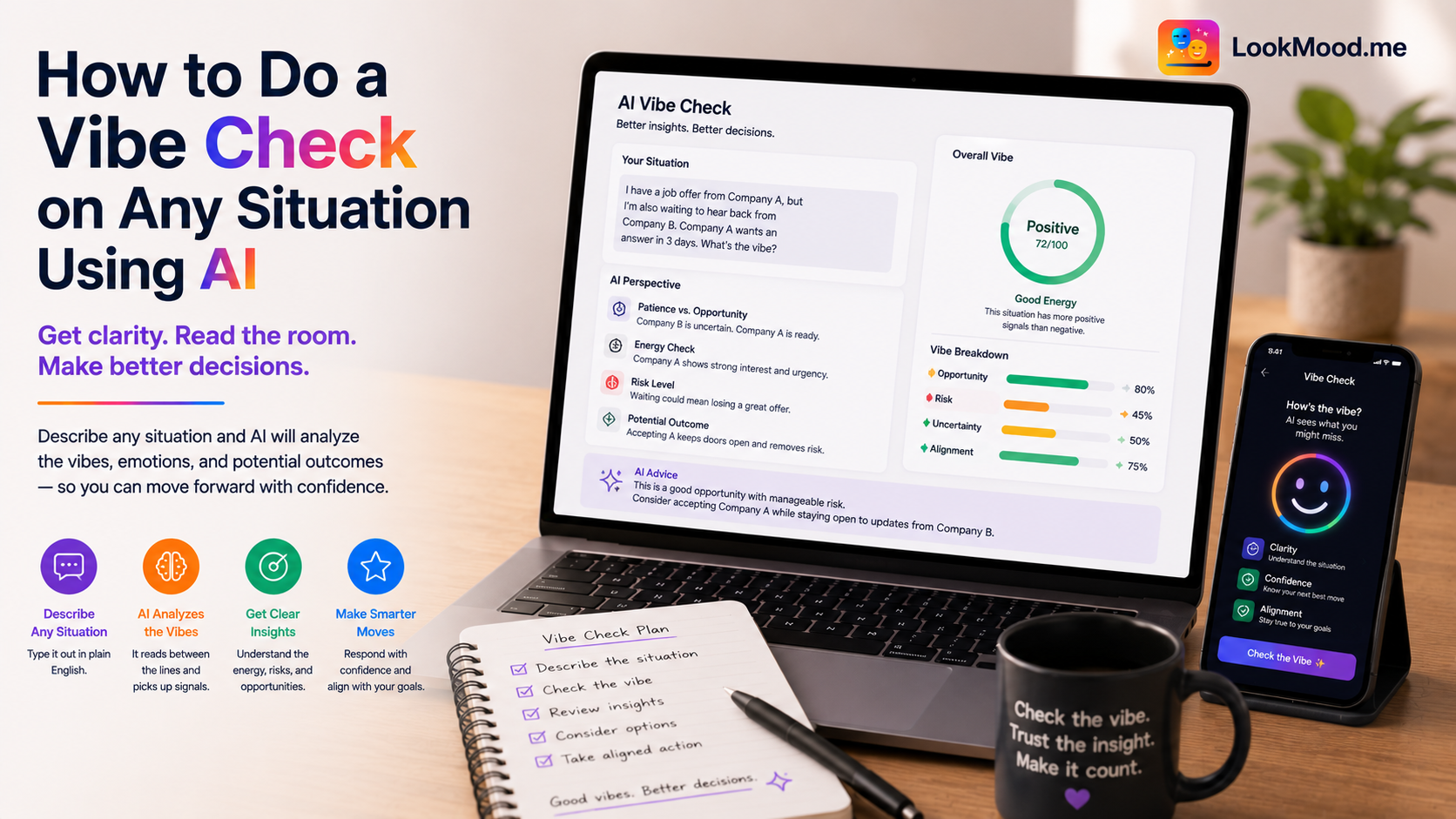
Something feels off about the situation. Not wrong, exactly — you can't point to anything specific — but a text came in slightly shorter than usual, or the meeting ended on a note that didn't sit right, or someone said something that could mean two completely different things and you're not sure which one they meant.
The vibe check is the act of checking your read against something external. Normally you do this by texting a friend ("does this seem weird to you?"). An AI vibe check is the same function — it gives you a second perspective on an ambiguous situation without requiring you to involve someone else in it.
What an AI vibe check is actually useful for
Not every situation needs a vibe check. Most things are straightforward. But certain categories of ambiguity are exactly where a second read helps:
- Ambiguous messages. A reply that could be read as dismissive or just efficient. An email with a tone you can't place.
- Post-meeting reads. A meeting that ended oddly and you're not sure how to interpret the room dynamics.
- Relationship dynamics. When a pattern of behavior has changed and you're trying to figure out what it signals.
- Before you send something. Does this message come across the way you intended? Will it land well or create friction?
In all these cases, the value isn't certainty — it's a more calibrated read. You don't outsource the judgment. You get a more structured way of thinking about it.
A worked example
Here's a specific prompt for LookMood AI's vibe check:
"I sent my manager a message asking about promotion timelines. She replied with 'Let's chat this week' and nothing else. We've been having these conversations for a while and she usually replies with more context. Does this seem neutral, positive, or like something is off? What are the most likely readings of this?"
A good response lays out the plausible interpretations without forcing one: she might want to have the conversation in person because it's substantive (positive signal — she's taking it seriously); she might be busy and keeping the reply short (neutral); she might have news that's easier to deliver verbally than in writing (could be either direction). It also notes the baseline deviation you flagged — if her usual pattern is more context and this is shorter, that's worth tracking, but it's not a clear negative signal on its own.
That's the output: not "you're fine" or "worry," but a structured map of the most likely readings and what would distinguish between them. You decide what to do with it.
When to trust your gut instead
AI is useful for decoding ambiguity. It's not useful for overriding a clear intuition. If something feels genuinely wrong — not ambiguous but clearly off — your instinct is probably picking up on something real. Don't AI-vibe-check your way out of a real signal.
The tool is for calibration, not reassurance. If you find yourself using it primarily to get told everything is fine, that's worth noticing — that's anxiety management, not situation reading, and a different type of help is probably more relevant.
Used well, the vibe check is a structured pause between feeling uncertain and acting on that uncertainty. It doesn't remove the decision. It just makes the information clearer before you make it.
For building a regular practice of checking in with your own emotional state, see why an AI mood journal might be the habit you actually stick to. And for a different kind of external-read use case, how to use AI to rate your outfit covers the visual context-reading version.