
How to Write Professional Emails With AI (Without Sounding Like a Robot)
· LookMood AI
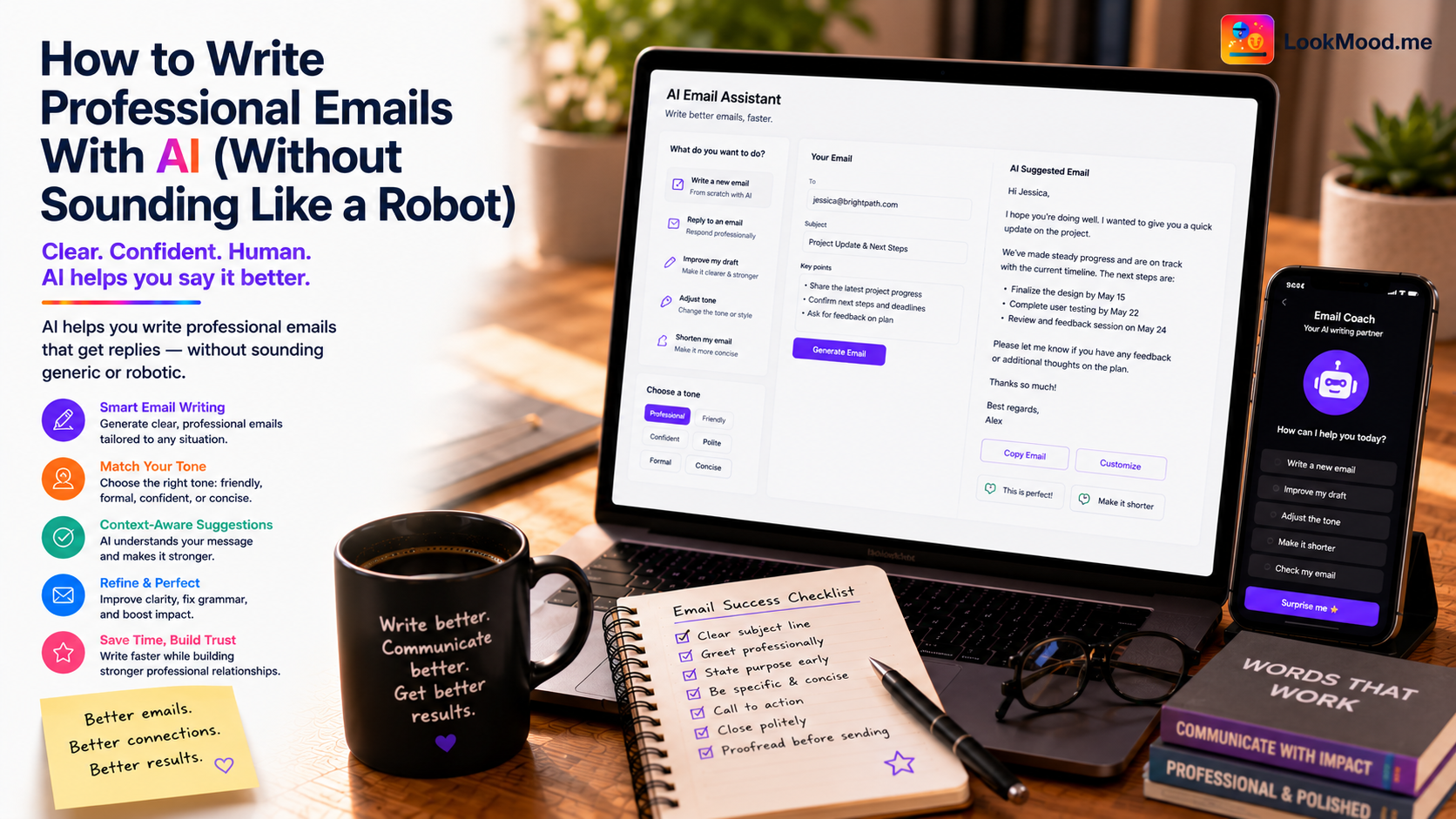
Twenty-five minutes on one email. Three drafts. You deleted the opening line four times because "Hi Sarah, I hope you're well" felt like filler but every other opener sounded either too blunt or too forward.
Professional email is one of those tasks where the stakes feel higher than the complexity warrants. You know what you need to say. Getting the tone exactly right for this person in this context — that's where the time goes. AI solves that specific problem cleanly.
What actually makes professional emails hard
Most professional emails fail at tone, not content. The information is fine. The ask is clear. But the email comes across as too pushy, too formal, too casual, or — the worst offense — too long. The reader scans it, gets the gist, and either responds or doesn't.
The challenge is that appropriate tone depends on context that you're inside of and the AI isn't. Your relationship with the recipient. The power dynamic. How many times you've followed up already. Whether this is good news or a difficult conversation. AI needs that context spelled out — but once you give it, it handles the calibration faster than you can.
A worked example
Here's a specific prompt for LookMood AI's email writer:
"Write a follow-up email to a client I haven't heard from in 3 weeks after sending a proposal. The proposal was for a $12,000 branding project. I don't want to sound desperate but I do want to move things along. The client seemed enthusiastic in our last call. Keep it under 100 words, professional but warm, and give me a subject line that's likely to get opened."
A good response gives you a draft that does exactly what you described: short, confident, assumes positive intent from the client ("I know you're likely busy"), creates a soft deadline without pressure ("happy to jump on a quick call this week if questions have come up"), and a subject line that references the project rather than saying "Following up" (which goes unread). It also usually gives you two subject line options in case one feels off.
From there you can iterate: "Make it slightly more direct — we've actually worked together before and this relationship is pretty informal." Or "Add a sentence about a new piece of work that might be relevant to their brief." The first draft is the 80% solution; you refine the remaining 20%.
Where AI email writing genuinely helps
The highest-leverage uses are the emails people dread writing:
- Difficult asks. Negotiating price, pushing back on a decision, requesting something awkward — AI finds the phrasing that's assertive without being aggressive.
- Saying no. Declining requests, turning down work, ending relationships gracefully — these are hard to write without either over-explaining or sounding cold.
- Intro emails. Cold outreach is notoriously hard to get right. AI knows the patterns that get responses and the patterns that get deleted.
- Long emails you need to make shorter. Paste in your draft and ask for a tighter version. Usually cuts 40% with no loss of meaning.
The one thing you always rewrite
The first sentence. AI consistently opens emails with something slightly generic, because it doesn't know the specific thing you know: that this person just got promoted, or that you met them at a conference last Tuesday, or that you're following up on a conversation that went really well. That specific human detail is what makes an email feel like it was written for one person, not a template.
Write the first sentence yourself. Let AI do the rest. That combination produces emails that are both efficient and actually personal.
If email is just one part of your writing workflow, see how to fix your writing with AI for longer-form work. And for handling a broader range of tasks at once, what an AI personal assistant can actually do covers how to stop using AI for just one thing at a time.