
How to Write a Resume With AI in 2026 (Without Sounding Like One)
· LookMood AI
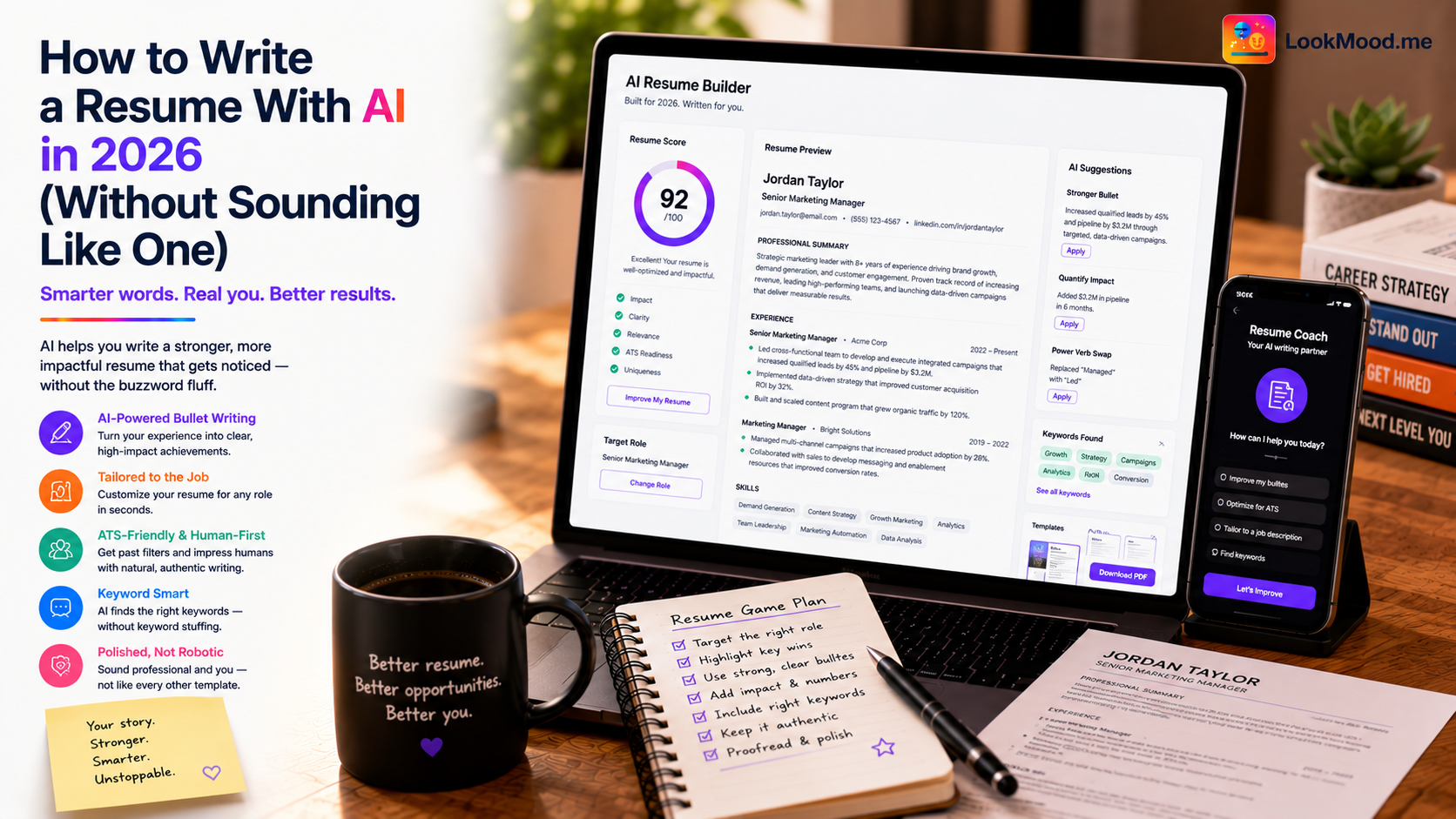
You rewrote your resume three times. Used a template from a career blog. Had a colleague read it. Added a skills section. Removed the objective statement because someone told you to. And still, for three roles you felt genuinely qualified for, nothing came back.
The problem usually isn't formatting. It's language — specifically, the mismatch between how you describe your work and how the job description talks about the role.
Why most resumes fail before a human sees them
Most large companies run applications through an Applicant Tracking System before they reach a recruiter. These systems scan for keywords and relevance signals. A resume that describes "managed internal communications" might score low on a role that wants "cross-functional stakeholder communication" — even if the work was identical.
This is where AI makes an immediate difference. It can read a job description and tell you exactly which phrases, skills, and signals are most prominent — then check whether your resume reflects them. That's not keyword-stuffing. It's making sure the language you use to describe real experience matches the language the company uses to describe what they want.
What AI does well on a resume — and what it doesn't
LookMood AI's CV builder is genuinely useful for four things:
- Language alignment. Comparing your CV language to the JD and flagging gaps.
- Rewriting bullet points. Turning "helped with quarterly reports" into "analyzed quarterly performance data and delivered briefings to C-suite leadership."
- Identifying what to cut. Most resumes are too long and too uniform — AI can flag which items are weak and which are pulling weight.
- Formatting guidance. Standard, recruiter-friendly formats versus creative formats that might work against you in ATS.
What AI isn't good at is making things up. It can only work with what you give it. If your work history has a gap, a lateral move, or experience in an unrelated industry, you still need to decide how to frame those things — the AI can help you word them clearly, but the strategic judgment is yours.
A worked example
Here's a specific prompt to try:
"Here's my current resume [paste resume]. Here's the job description for a Senior Product Manager role at a SaaS company [paste JD]. Rewrite my experience bullet points to better match what they're looking for, and tell me what's currently missing or weak."
A good response returns a specific critique — "Your bullets don't mention user research, which appears four times in the JD" — along with rewritten versions of key bullet points, suggested additions based on your existing experience, and a recommendation on which projects to lead with.
From there you iterate: "Now write a version of this for a product marketing role instead." Each JD is different. The resume should shift accordingly. You're not sending one document to fifty companies — you're sending tailored versions, and AI makes that feasible.
The biggest mistake with AI resumes
Treating the AI's first output as the finished document.
AI gives you a strong first draft. A draft is not a resume. You need to read every line and make sure it sounds like you — not like a resume a machine wrote. Hiring managers are good at spotting AI prose. The specific, concrete details that make a resume memorable (a real metric, a project name, a recognizable client) have to come from you.
Generate with AI. Edit ruthlessly. The resume that gets you an interview is specific, credible, and clearly written by someone who knows their own work.
Once your resume is sharp, the next step is knowing where to send it — see how to find a job with AI for targeting and personalization. And once you land the interview, how to prepare for a job interview with AI covers what to do so you're not going in cold.