
How to Find a Job With AI: Stop Applying to Everything
· LookMood AI
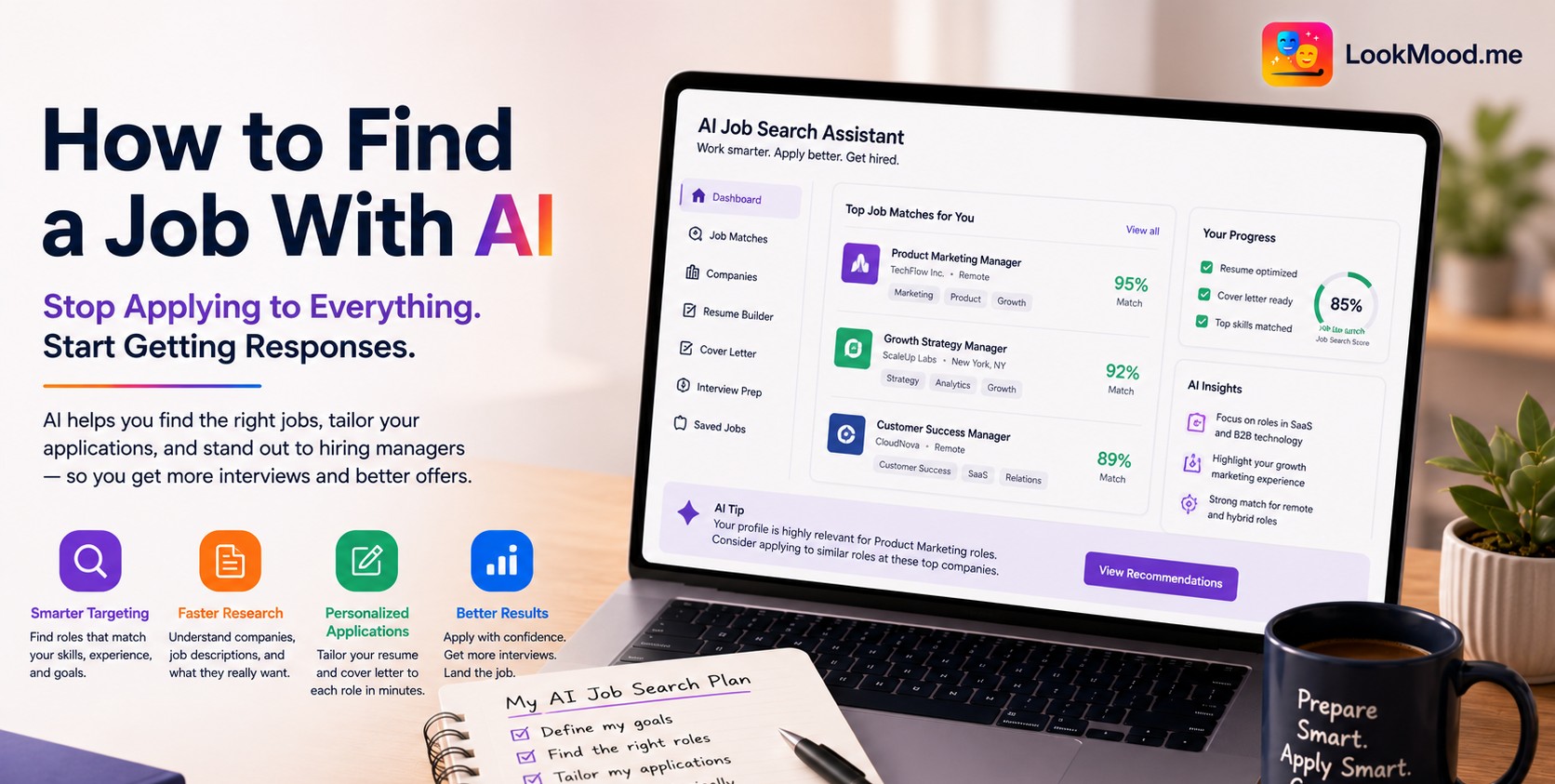
You sent out 50 applications in six weeks. Two interviews. One ghost. One polite rejection. And now you're wondering whether you're doing something wrong or whether the market is just broken.
Both, probably. But the fixable part is the targeting.
The most common job search mistake in 2026 is treating applications as a numbers game — applying wide, applying fast, hoping volume produces results. It doesn't. Hiring managers at most companies receive hundreds of applications per role. The ones who move forward feel tailored, specific, and like the applicant actually read the job description. AI can help you get there faster.
What AI is actually useful for in job search
AI doesn't find jobs for you. Let's be clear about that. Job boards still exist. Networking still matters. Referrals still carry more weight than a cold application. What AI does is compress the research and personalization work that most people skip because it's tedious.
Specifically, AI is useful for:
- Identifying roles that match your background. Tell it your experience, skills, and what you're looking for. It maps titles and role types you might not have thought to search.
- Scanning job descriptions. Paste in a JD and ask what it's really looking for — not just the listed requirements, but the implied priorities in how the role is described.
- Tailoring your pitch. Based on what the JD signals, what should you emphasize? What experience is most relevant for this specific hiring manager?
- Mapping companies you haven't considered. Which companies in your target industry are hiring for roles like yours? Which are growing? Which are more selective?
A worked example
Here's a specific prompt you might use in LookMood AI's job search agent:
"I'm a project manager with five years in tech startups, PMP certified, mostly managing software launches. I want to move into operations or chief-of-staff type roles at a Series B or C company. What roles should I be targeting, and what should I search for on LinkedIn?"
The response maps out role titles that fit that background (Head of Operations, Strategy and Operations Manager, Chief of Staff, BizOps Lead), the industries most likely to need that profile, suggested company sizes and funding stages, and the key search terms to use on LinkedIn and similar platforms. That's an hour of research done in under a minute.
From there, you go specific: "I found a job at Acme Corp as a BizOps Manager. Here's the JD. What aspects of my background should I highlight in my cover letter?" The loop is broad targeting, then specific tailoring, repeated for each application.
The part people underestimate
AI gets you to the shortlist faster. But the shortlist is still competitive, and the final decision is human.
That means your CV still has to be sharp, your cover letter still has to feel like a person wrote it, and your interview preparation still has to be thorough. AI can help with all three — but it can't replace your ability to articulate why you specifically want this role at this company.
The candidates who treat AI as "generate application, send, repeat" quickly produce a volume of generic, clearly-templated applications that hiring managers spot immediately. The candidates who use AI to research smarter and personalize better are the ones who get the callbacks.
Before you apply anywhere, spend a few minutes asking the AI what it can tell you about the company, the role, and how to position your experience. That conversation is what separates a good application from a forgettable one.
Once you're getting interviews, the next step is making sure your materials hold up under scrutiny. See how to write a resume with AI in 2026 for the CV side, and how to research a company before your interview so you show up knowing more than the average candidate.