
How to Research a Company Before an Interview (Beyond the About Page)
· LookMood AI
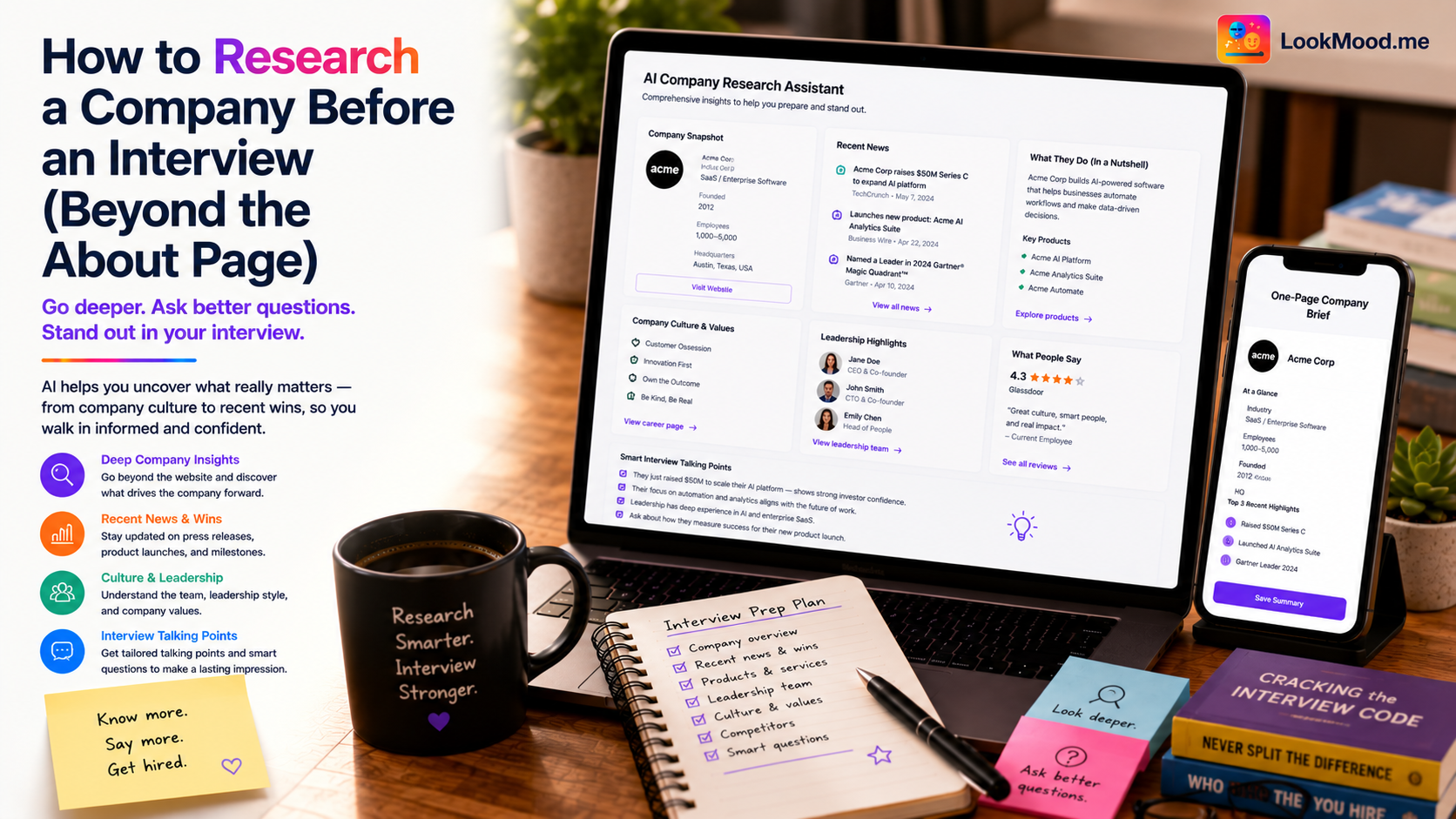
You get the interview. Three days later you're scanning the company's "About Us" page, reading a Medium article the CEO wrote in 2023, and scrolling your interviewers' LinkedIn profiles. By the morning of the interview, you feel like you've done your homework.
Except every other candidate did the same research. In the same places.
Real company research — the kind that gives you an edge — isn't on the About page. It's in the details: what the company is currently hiring for, what it's stopped hiring for, what customers say about the product, where the company has struggled publicly, what recent moves signal about strategic priorities. AI compresses the time it takes to find all of this into minutes.
What the About page won't tell you
The things that matter most about a company in an interview context are rarely documented anywhere obvious:
- Is this a company where engineers run things, or one where sales drives decisions?
- Is the culture actually collaborative, or just described that way in the handbook?
- What are the real pain points the team is dealing with right now?
- Is the company growing, or has hiring quietly slowed in the past six months?
- What do current and former employees actually say about the work?
These questions are answerable. They just require looking in the right places — or asking something that already has.
What you're actually trying to learn
Company research before an interview serves three distinct purposes, and most candidates only do one of them.
Understanding the role in context. The job description tells you what they want. Research tells you why they need it, what problem they're solving, and how this role fits into the company's current priorities. That context shapes how you talk about your experience.
Preparing specific questions. An interviewer can immediately tell the difference between "I did some research on your company" and "I noticed you recently launched [specific product] — I'd love to understand how this role contributes to that." Specific questions signal serious interest. Generic questions signal you filled a slot on the calendar.
Deciding if you actually want the role. Most candidates treat research as something you do to impress the interviewer. The better reason to do it is to figure out whether this is a good company to work for. Glassdoor reviews, news from the past six months, how the company handled a rough patch — these things tell you a lot.
A worked example
Here's a specific prompt for LookMood AI's company research agent:
"I'm interviewing at Stripe next week for a senior product manager role on their merchant payments team. Research the company for me: recent news, culture, what they value in senior PMs, what the interview process typically looks like, and what questions I should be prepared to answer."
The response gives you a current picture of Stripe's strategic priorities, what senior PMs actually work on at that company, the interview stages you're likely to face (Stripe's process is well-documented by past candidates), the attributes Stripe emphasizes in hiring, and the questions that come up most commonly for senior PM roles there.
That's two or three hours of Glassdoor, LinkedIn, the company blog, and interview review sites — done in under a minute. Then go deeper on any section: "Tell me more about the merchant payments team specifically" or "What are the most common reasons candidates get rejected at the final round?"
Using research in the interview itself
Research is only useful if you use it.
The best interviewers welcome specific questions. "I read that you launched X last quarter — how is that going?" is a better question than "What does success look like in this role?" It shows you paid attention and have a real interest in the work, not just the offer.
Research also protects you from being caught flat-footed. If you know the company had layoffs six months ago, you're not visibly surprised if it comes up. If you know the product has public criticism, you can engage with that intelligently rather than pretending the company is perfect.
Go into every interview knowing three things the average candidate doesn't. That's the difference between a good interview and a memorable one.
For the interview preparation side — building answer frameworks and practicing under pressure — see how to prepare for a job interview with AI. And if you're still building the application funnel, how to find a job with AI covers the targeting and personalization work that comes first.