
How to Prepare for a Job Interview With AI: Close the Feedback Gap
· LookMood AI
You came out of the interview feeling good. You'd answered every question. You'd told the right stories. Two days later, a polite rejection email. No feedback. No reason.
This is the most frustrating part of interviewing — not the rejection, but the silence. Without feedback, you can't improve. Without knowing what went wrong, you prepare the same way next time and run the same risk. AI doesn't change the human judgment at the end. But it can close the feedback gap before you walk in.
Why rehearsing answers in your head doesn't work
Most people prepare by reading lists of common interview questions and running through answers mentally. Some record themselves. A few practice with a friend.
All of these have the same problem: no calibration. You know what you said, but not how it landed. You know the content of your answer, but not whether you sounded confident, scattered, too rehearsed, or genuinely engaged.
Practicing without feedback is like going to the gym without knowing whether the exercise is working. You might improve. You might be reinforcing bad habits.
What AI coaching gives you that prep lists don't
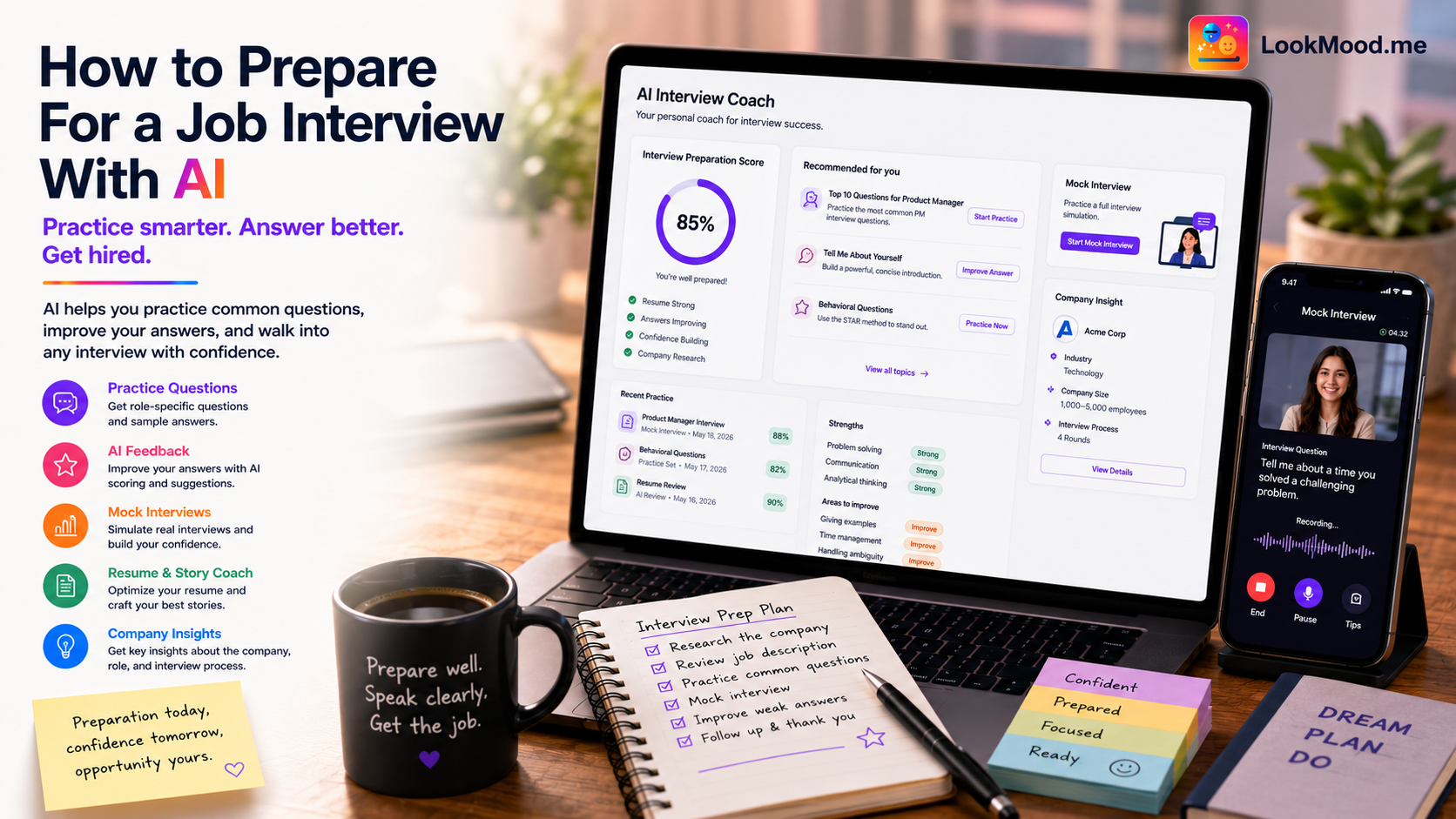
A good interview coach doesn't give you generic questions — they give you intelligence about the specific interview you're walking into. LookMood AI's career coach does three things a list of common questions can't:
Company-specific prep. Not "tell me about yourself" — the real questions that come up in this company's interview process, based on the role and what companies like this typically care about.
Answer frameworks built from your background. Behavioral questions — the "tell me about a time when..." variety — have a structure: situation, task, action, result. AI helps you map your real experience to that structure before you're under pressure in the room.
Practice on questions you're avoiding. Most candidates prepare thoroughly for questions they're comfortable with and sidestep the uncomfortable ones. Ask the AI to push you on your weakest areas.
A worked example
Here's a specific prompt:
"I'm interviewing for a Director of Engineering role at a mid-size fintech company next Thursday. The job description emphasizes cross-functional leadership and 'shipping at scale.' I've been a tech lead for three years but never formally managed a team. What are the hardest questions I'm likely to face, and how should I prepare for them?"
A good response returns the specific questions a fintech company would ask a candidate making that leap — they will probe your lack of formal management experience directly — along with a framework for each: what the interviewer is really testing for, what a strong answer covers, and what to avoid saying.
Then run your answer back: "Here's how I'd answer the management experience question. What's weak about it?" You get specific feedback on where the answer is thin, where it's credible, and what's missing.
The day before the interview
The most common mistake is cramming the night before. By then, your answer preparation should be done. The night before is for one thing: knowing the company cold.
What's changed at the company recently? What's the product actually doing in the market? Who are the founders? Why do you specifically want this role at this company — and can you answer that question without it sounding like a prepared line?
If you can't answer that last question convincingly, the interviewer will feel it. No amount of rehearsed answers covers for someone who clearly didn't think about whether they actually want the job.
For the company research side of preparation, see how to research a company before an interview. For a deeper look at the full preparation sequence — timing, confidence, presence — see LookMood's AI interview prep guide.