
How to Make Better Decisions Using AI as a Thinking Partner
· LookMood AI
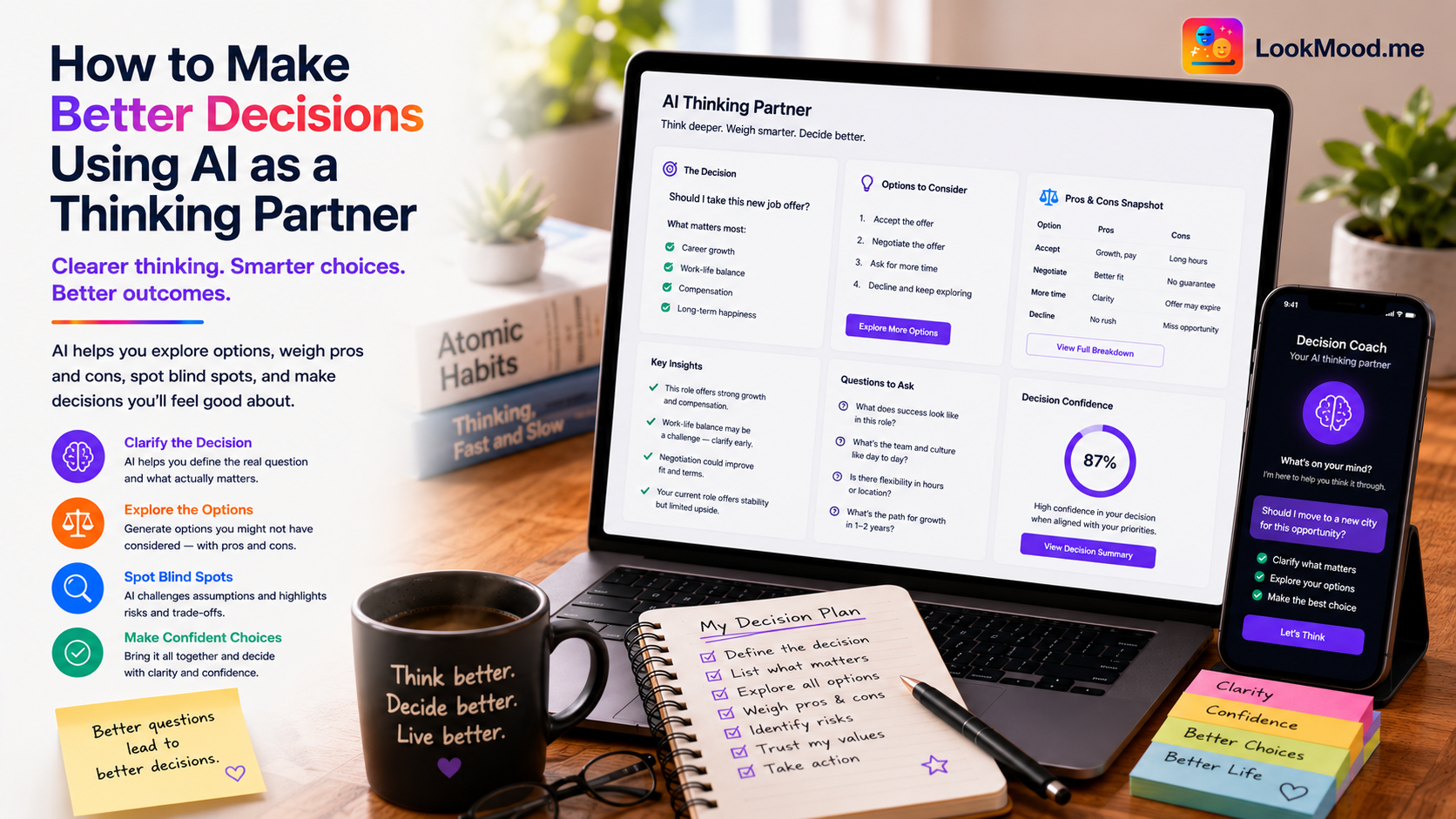
The decision has been sitting on your desk for two weeks. You've listed the pros and cons three times. You've asked two friends who gave you opposite advice. You know the relevant information — you've been over it enough times — but you still don't know what to do.
This isn't an information problem. It's a structure problem. When you've been circling a decision for too long, you've usually lost the ability to see it clearly. You know too much about it, have too many feelings about it, and have pre-committed to framings that might be wrong. A fresh perspective that has no stake in the outcome is exactly what you need. That's precisely what AI is useful for here.
What AI actually does for decision-making
AI isn't going to tell you what to do. If you want someone to make your decisions for you, that's a different problem. What AI does well is structure the decision more clearly than you can when you're inside it.
Specifically, AI is useful for:
- Surfacing the assumptions you're making. Most decisions feel stuck because of a hidden assumption that hasn't been examined. AI can often find it.
- Playing devil's advocate. You've heard the argument for the option you're leaning toward. Ask AI to make the strongest possible case for the one you're avoiding.
- Pre-mortem analysis. Ask: "Assume I chose Option A and it went badly. Walk me through the most likely reasons it failed." This is a standard decision-making technique that AI executes well.
- Clarifying what you're actually optimizing for. Sometimes the decision feels hard because you're trying to win on multiple dimensions simultaneously. AI helps you prioritize.
A worked example
Here's a specific prompt for LookMood AI's decision maker:
"I'm trying to decide whether to leave my current job at a stable company for a startup offer. The startup pays 20% more but the equity is speculative and I'd be going from a senior manager role to an individual contributor. I've been going back and forth for two weeks. I'm not asking you to decide for me — I'm asking you to tell me what I'm probably not thinking about clearly and ask me the three questions I should be asking myself before I make this decision."
A good response identifies the real friction (the IC to manager step-down is likely the emotional sticking point more than the pay), surfaces the questions most people avoid in this scenario (What does failure look like at the startup, and could I live with that? Why am I at the stable job — am I content or just comfortable?), and flags the assumption most people make wrongly in this situation (that "more pay" and "speculative equity" belong on the same side of the ledger).
That output doesn't make the decision. It changes how clearly you can see it.
When to use AI and when to call the person who knows you
AI is useful for decisions that have clear information components — where research, structure, and framework help. It's less useful for decisions that are primarily about values or identity, where the right answer depends entirely on who you are and what you actually want out of life.
A decision about job offer logistics is a good AI problem. A decision about whether you even want to keep working in this industry is a question for your therapist, your partner, or a long walk.
The most productive use of AI in decision-making is to clear the information and structure layer so that whatever remains is the actual question — the one only you can answer.
For general task handling and productivity, see what an AI personal assistant can actually do. And for improving how you communicate decisions once you've made them, how to fix your writing with AI covers the document and communication side.