
How to Stay Informed Without Doom-Scrolling: AI News That Helps
· LookMood AI
You opened the app to get a quick sense of what's happening in the world. Twenty-five minutes later you've seen fourteen takes on one story, three argument threads, and a video that had nothing to do with news but had a compelling thumbnail. You're more agitated than when you started and you couldn't summarize the actual events of the day if someone asked.
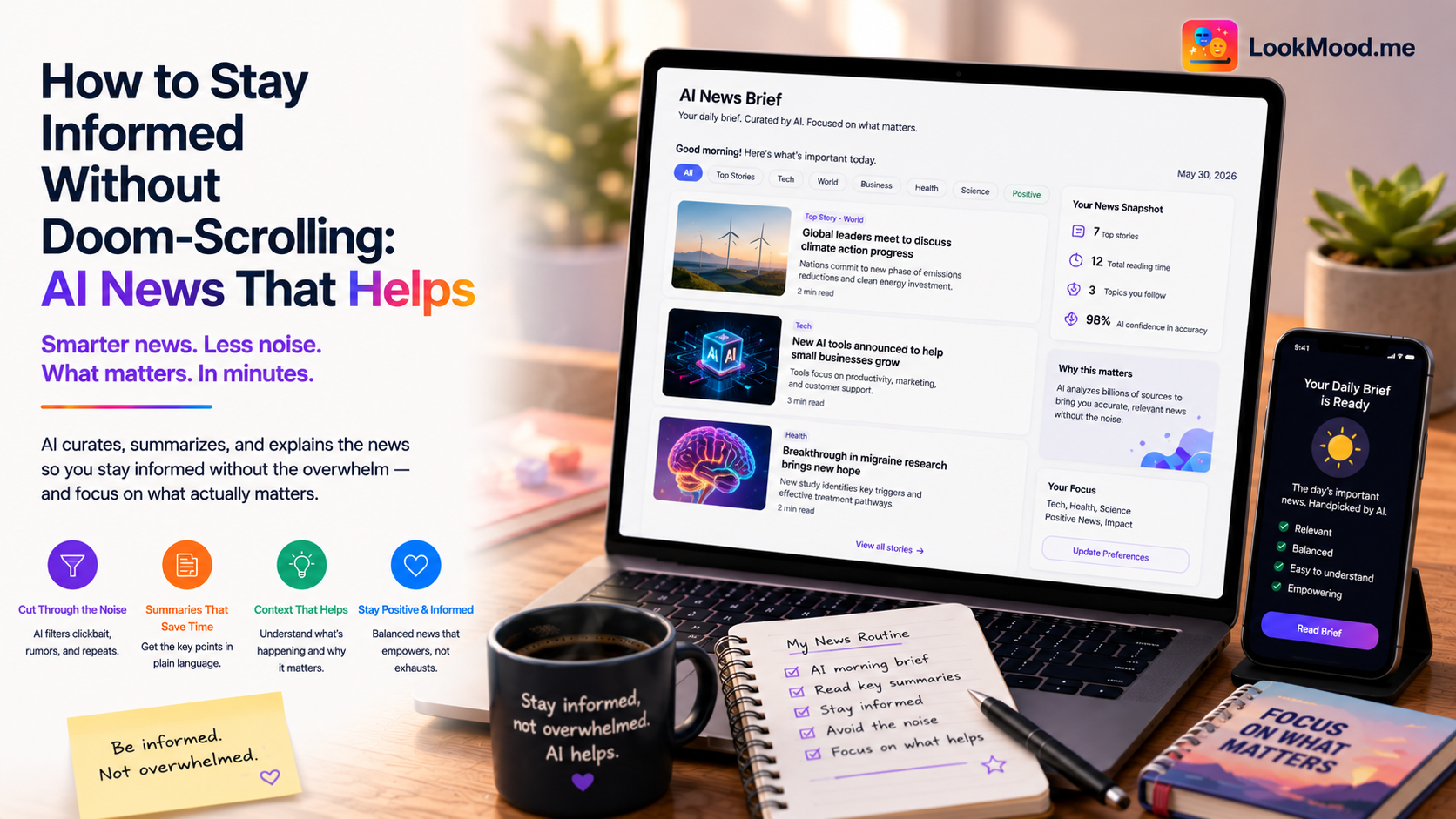
This is the standard news experience in 2026. The platforms aren't designed to inform you — they're designed to keep you engaged. Those two goals diverge significantly. AI news is a different model: ask what matters, get a clear answer, and move on with your day.
What's wrong with the standard news experience
The problem isn't that there's too much news. It's that the format prioritizes engagement signals over informational value. The most-shared story is not always the most important story. The most commented headline is often the most emotionally provoking one, not the most accurate one. The algorithm serves you more of whatever kept you on screen — which means if you read one angry take, you get fifteen more.
AI news sidesteps this by responding to what you actually ask for rather than optimizing for your engagement. You control the query. You get the answer. The feedback loop that leads to doom-scrolling doesn't have a chance to start.
A worked example
Here's a specific prompt for LookMood AI's news agent:
"Give me a five-minute briefing on today's most important news across these areas: US politics, global economy, and tech. Keep it factual and brief — I want the what and the why, not the takes."
A good response gives you a structured briefing: two or three sentences per topic, covering what happened, why it matters, and what happens next. No commentary on what to think about it. No hot takes. No outrage framing. Just a clear summary of events with enough context to understand the significance.
You can go deeper on any item: "Tell me more about the Fed decision — why does it matter for mortgage rates?" The AI becomes a patient explainer who has time to give you context without the pressure of a word count or an engagement metric.
The full briefing takes about five minutes to read. You're actually informed. You can get on with your day.
What AI news doesn't replace
Primary source journalism. Investigative reporting. The detailed accountability work that takes months to produce. AI news summaries are built on journalism that exists — they don't replace the journalism itself.
If a story matters to you, read the original reporting. AI is good at helping you identify which stories are worth your longer attention, and at giving you enough context that when you do read the original piece, you're oriented. It's a triage tool, not a replacement.
The goal is informed without overwhelmed. Ten minutes of focused AI briefing gets you more actual information than an hour of algorithm-driven scrolling — and leaves you with enough mental energy for the rest of the day.
For handling more of your daily information tasks, what an AI personal assistant can actually do covers the broader workflow use case. And for days when you're facing a decision and need context rather than events, how to make better decisions with AI is a related approach to getting clarity without the noise.