
How to Find the Best Price for Anything Online Using AI
· LookMood AI
You need new running shoes. You know the model you want. You've spent forty minutes comparing prices across six websites, found three different numbers, read a Reddit thread saying there's a better model anyway, and now you're less decided than when you started.
Price research has a point of diminishing returns that most people blow past. The difference between a thoughtful ten-minute search and a two-hour exhaustive one is rarely more than a few dollars — but the two-hour version produces decision fatigue that often ends in either a bad impulse purchase or no purchase at all. AI compresses the useful research into the first ten minutes.
Where prices actually differ (and where they don't)
Not every purchase benefits from price comparison research. For commodity products on Amazon with Prime shipping, the price is usually close to market rate and the comparison effort isn't worth it. For higher-ticket items, purchases with meaningful price variance across retailers, or anything with seasonal pricing, the research pays off.
Categories where AI price research consistently adds value:
- Electronics. New releases, older models going on sale, refurbished versus new — price gaps can be 20–40%.
- Travel. Flight and hotel prices are genuinely dynamic. The same seat can vary by hundreds of dollars based on timing and booking channel.
- Appliances and furniture. Seasonal sales cycles are real (Black Friday, January sales), and floor model or outlet pricing can be significantly lower.
- Subscriptions and services. Annual versus monthly pricing, student discounts, new customer promos — these aren't advertised prominently but often exist.
A worked example
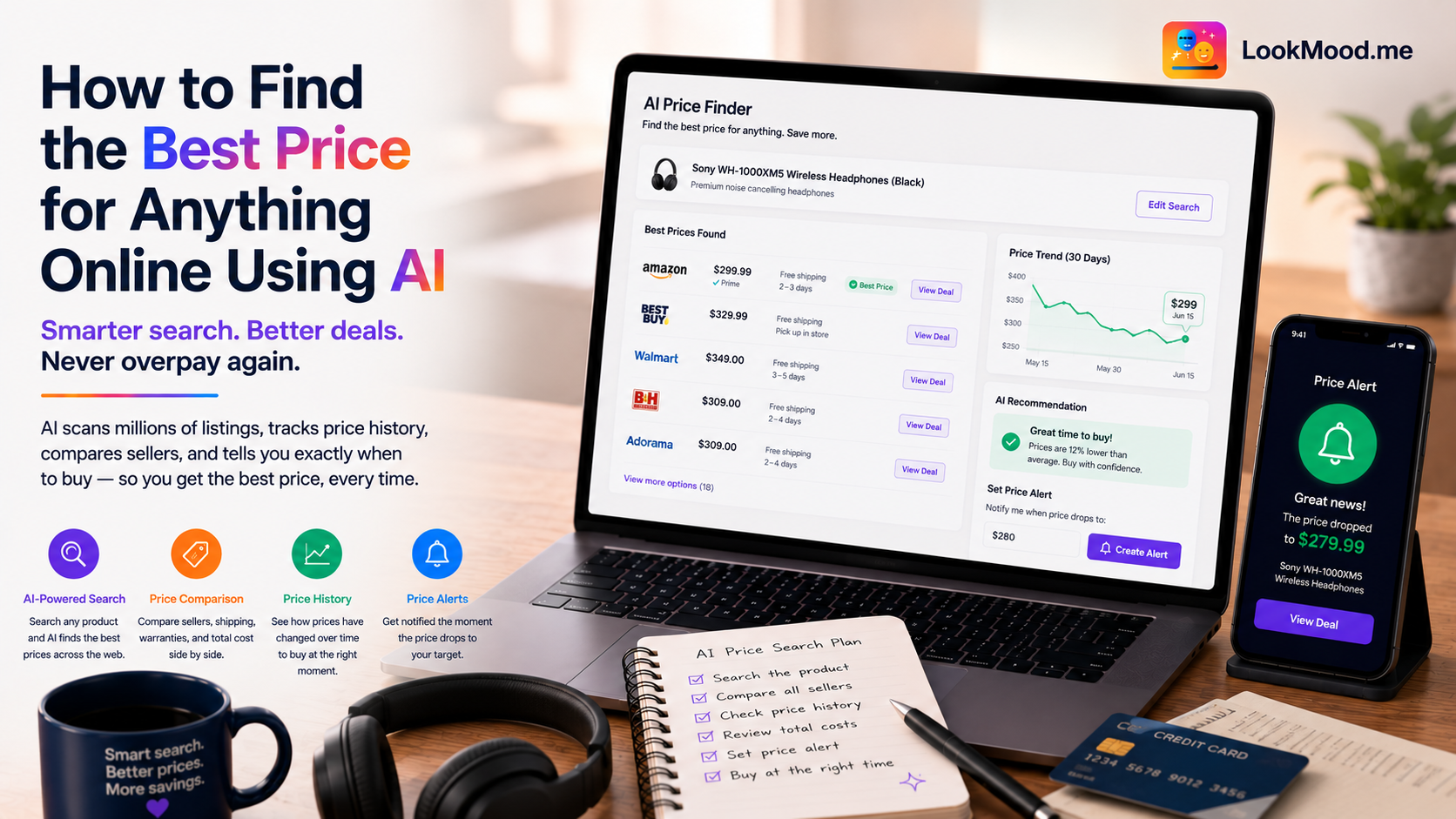
Here's a specific prompt for LookMood AI's price finder:
"I want to buy a Sony WH-1000XM5 headphones. I'm in the US. What's the typical price range, where does it tend to be cheapest, is there a better time of year to buy, and is there a comparable alternative I should consider at a lower price point?"
A good response gives you the realistic retail range ($280–350 depending on retailer and timing), identifies where it's typically discounted (Amazon during Prime Day, Best Buy during their sales cycles, B&H Photo for competitive gray market pricing on electronics), flags that the XM5 often drops to around $250 in November, and mentions the Sony XM4 as a credible alternative at $200–230 with slightly lower active noise cancellation but otherwise comparable for most users.
That's the research done. You can now make a decision: buy now at current price, wait for November, or go with the XM4. Three options, clear tradeoffs, no more tab-switching.
When it's worth the research and when to just buy
A useful rule: research is worth doing when the potential saving is either large in absolute terms (more than $20–30 for most purchases) or large in percentage terms (more than 15% off the standard price). Below that threshold, the time cost of research usually exceeds the monetary saving.
The other useful thing AI does here is stop the research spiral. Ask your question, get a clear answer, make a decision. The goal is to buy the right thing at a fair price with minimal time wasted — not to find the theoretically cheapest option in the universe if you're willing to wait six months and use a specific credit card portal.
For broader task handling, see what an AI personal assistant can actually do — shopping research is one of many things it handles well. And for decisions with more tradeoffs than pure price, how to make better decisions with AI covers the structured thinking approach.