
Why an AI Stock Score Is a Guess in a Suit
· LookMood AI
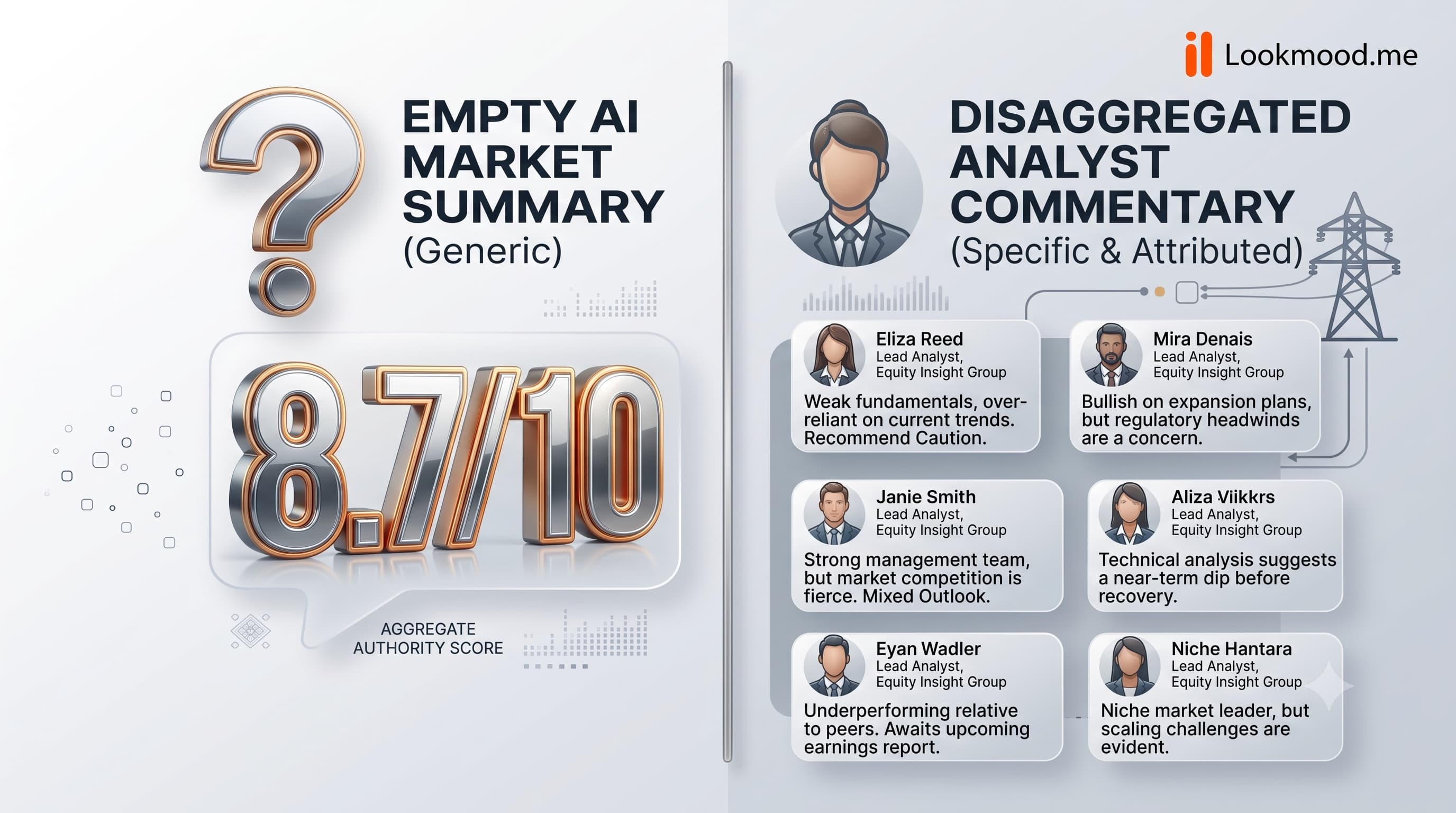
A number carries authority that a sentence doesn't. "This looks fairly promising" invites you to weigh it. "8.7 / 10 — high conviction" invites you to act on it.
So it's worth asking, every time you see one: what produced that number? For a language model reading recent news about a company, the honest answer is that nothing did. There's no backtest behind it, no validated model, no base rate. It's a plausible-looking figure generated because a score was requested.
That's a guess. The decimal point is what makes it a guess in a suit.
The problem with a number you can't check
A genuine probability can be wrong in a way you can measure. If something forecasts 70% and the 70% cases come true about seven times in ten, it's calibrated. If they come true twice in ten, it isn't, and you can prove it.
A generated score offers no such handle. If a stock rated 8.7 falls, the score wasn't wrong — high conviction calls fail sometimes, that's the nature of markets. Every outcome is compatible with every score. Which sounds like sophistication and is actually the opposite: a claim that nothing can contradict isn't a strong claim, it's an empty one.
The practical consequence is that you can never learn whether to trust it. Trust normally builds through a track record of things turning out. A score that can't be scored gives you nothing to build on.
There is real expertise out there. It has names attached.
Here's the thing that makes the score unnecessary: a great deal of genuine analysis already exists on most listed companies. Analysts publish research. Firms revise targets and say why. Institutions take positions and file them. Ratings get upgraded and downgraded, on the record, by people whose job it is and whose history you can look up.
That's real information, and it's attributable. "Three firms raised their targets this week and one cut, with the cut citing margin pressure in the Asian business" is a fact about what informed people have concluded. You can look up whether that firm has been right before. You can notice that the spread of views is wide, which is itself a signal.
Compare that to a synthesised number that flattens all of it into one digit and detaches it from anyone accountable for it. The second is easier to read. The first is the one you can actually use.
Where the real work is
Genuinely useful research on a company isn't a verdict. It's a set of answers to boring questions that take real time to assemble.
What's actually happened recently, and what did each thing mean rather than just what the headline said. What's scheduled — earnings, filings, court dates, product events — because timing changes how a piece of news lands. What people who follow the company closely have actually said, each attributed to the firm that said it. Which numbers matter for this kind of business, with a source next to each one.
None of that is glamorous, and none of it requires a prediction. It's the work of gathering scattered material into one place so a person can read it in five minutes instead of forty. That's a real service, and it happens to be exactly the sort of thing software is good at — unlike forecasting, which it is not good at, whatever the interface suggests.
The line, and why it's worth holding
Report what happened. Report what named people have said about it, with attribution. Show the sources. Say plainly when something isn't known.
Don't generate a rating. Don't produce a target. Don't tell someone what to buy, or dress a recommendation as a probability and hope the framing covers it.
This isn't only caution. A tool that hands you a verdict is asking you to stop thinking at the exact point where thinking matters, and it's asking that on the strength of a number it made up. A tool that hands you organised, sourced information leaves the judgement with you — which is both the safer arrangement and, if you're the one whose money is at risk, the more respectful one.
LookMood AI's Stock Research reports recent news and what it means, what's coming up, what named analysts have actually published, each attributed to the firm behind it, and key metrics with sources on each. No score, no target, no recommendation — because the useful part was never the verdict. For the market as a whole rather than one company, see why most AI market summaries say nothing.