
Why Most AI Market Summaries Say Nothing
· LookMood AI
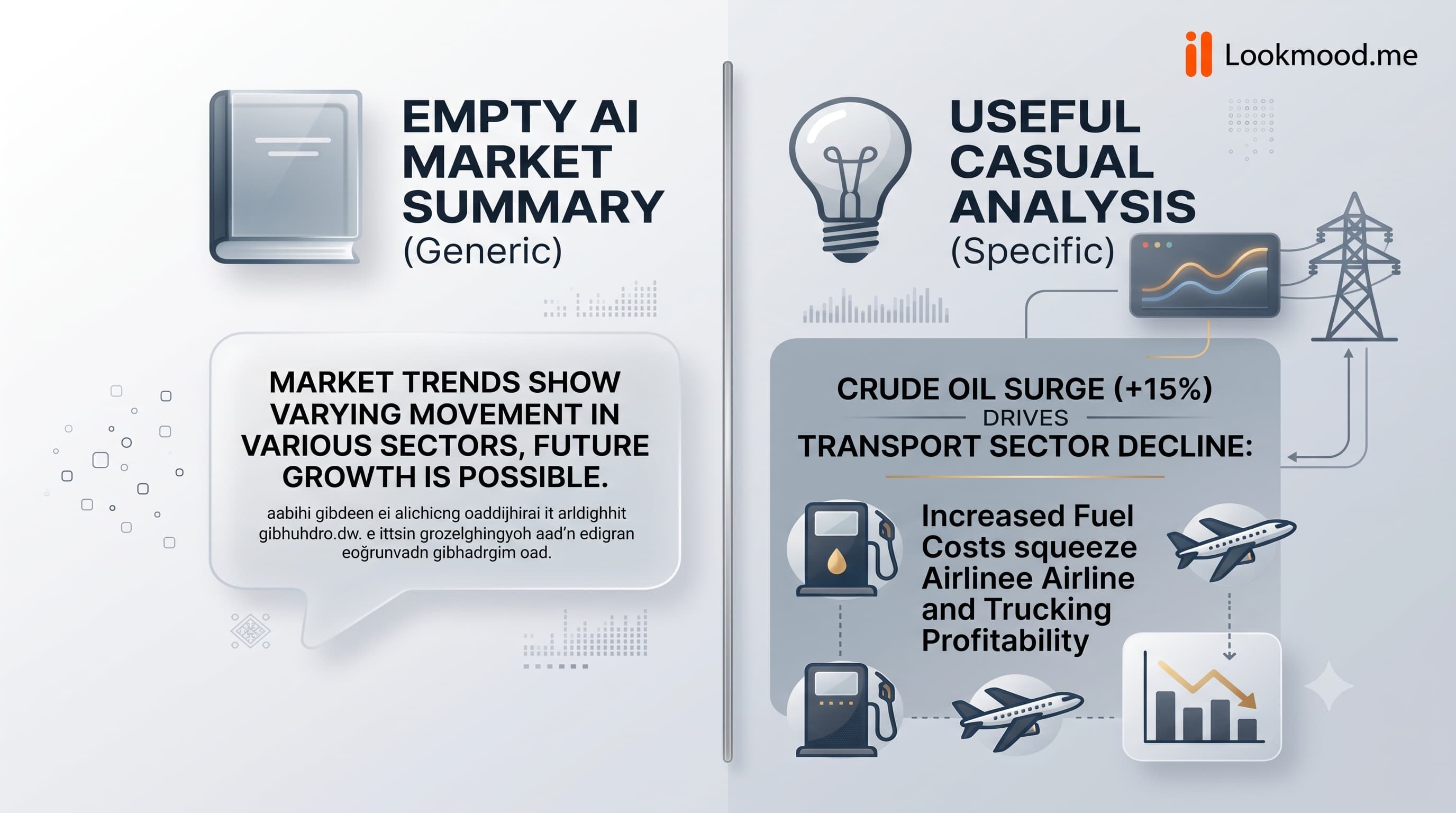
Here is a market summary: stocks were mixed as investors weighed economic concerns ahead of key data later this week.
Read it again and ask what you learned. Which stocks. Which concerns. Which data. The sentence is grammatically complete, sounds like finance, and contains no information at all. It would have been true on Tuesday. It will be true next Tuesday.
This is the standard output of most automated market coverage, and it's worth understanding why — because the reason isn't laziness.
Filler is what a summary reaches for when it doesn't know why
Reporting that an index closed down 0.4% is easy. The number is public, it's on every finance site within seconds of the close, and no interpretation is required.
Explaining why it closed down 0.4% is a different kind of work. It means reading across a dozen sources, noticing which stories are actually connected, and separating the thing that moved the market from the four things that merely happened on the same day.
When a tool can't do that second part, it still has to produce a paragraph. So it produces one that fits any day — cautious sentiment, mixed signals, investors awaiting clarity. The phrasing sounds analytical because it borrows the vocabulary of analysis. It just never commits to a claim specific enough to be wrong.
That's the test worth applying to any market summary you read: could this sentence have been written about last Thursday? If yes, it hasn't told you anything.
The part that's actually hard is the connection
A list of the day's biggest movers isn't hard to produce. Any screener does it. What nobody assembles for you is the pattern underneath.
Eleven of the fifteen biggest fallers being banks isn't a coincidence, and noticing it changes what the day means. A broad market decline and a sector-specific one look identical in the index number and are completely different events. One is a mood; the other has a cause you can name, trace to an announcement, and reason about.
This is where reading across many live sources earns its keep. A single headline tells you one company fell. Twenty headlines read together tell you nine of them fell for the same reason, and that reason is a draft regulation published that morning that most of the coverage hasn't connected yet.
That connective work is genuinely useful and genuinely tedious — which is a good description of the tasks worth handing to software.
Naming the driver, or admitting there isn't one
Some sessions have a clear cause. An inflation print, a central bank statement, an oil move, one enormous earnings miss dragging a whole sector. On those days a summary should say so plainly and show the link.
Other sessions genuinely don't. Markets drift. Nothing much happened. The honest report on a day like that is that nothing much happened — not a manufactured narrative about cautious positioning ahead of unspecified catalysts.
Inventing a driver is the same failure as inventing a number. It fills the gap where knowledge should be with something shaped like knowledge, and the reader can't tell the difference. A summary willing to say "no single story dominated today" is more trustworthy than one that always has an explanation ready, because the second one is clearly generating explanations rather than finding them.
What a session summary is actually for
Not to tell you what to do. A summary that ends with a recommendation has quietly changed jobs — and a recommendation generated from a day's news is a guess wearing a suit.
It's to answer the question you actually opened it with: what happened while I wasn't watching, and does any of it matter to me? That's four things. What moved. Why. What moved together. What's scheduled next that could matter.
Get those four right, with sources attached so you can check any of them, and the reader is better informed than they were two minutes ago. They can then do their own thinking, which is the part that was always theirs.
LookMood AI's Stock Market Analysis works this way by design: what happened, what drove it, what moved together and why, what's coming — for whichever exchange you're watching, sourced rather than guessed. No scores, no targets, no calls. If you want the same treatment for one company rather than a whole market, that's a different problem, and worth reading about.