
Why AI Translations Get Idioms Wrong (Even the Good Ones)
· LookMood AI
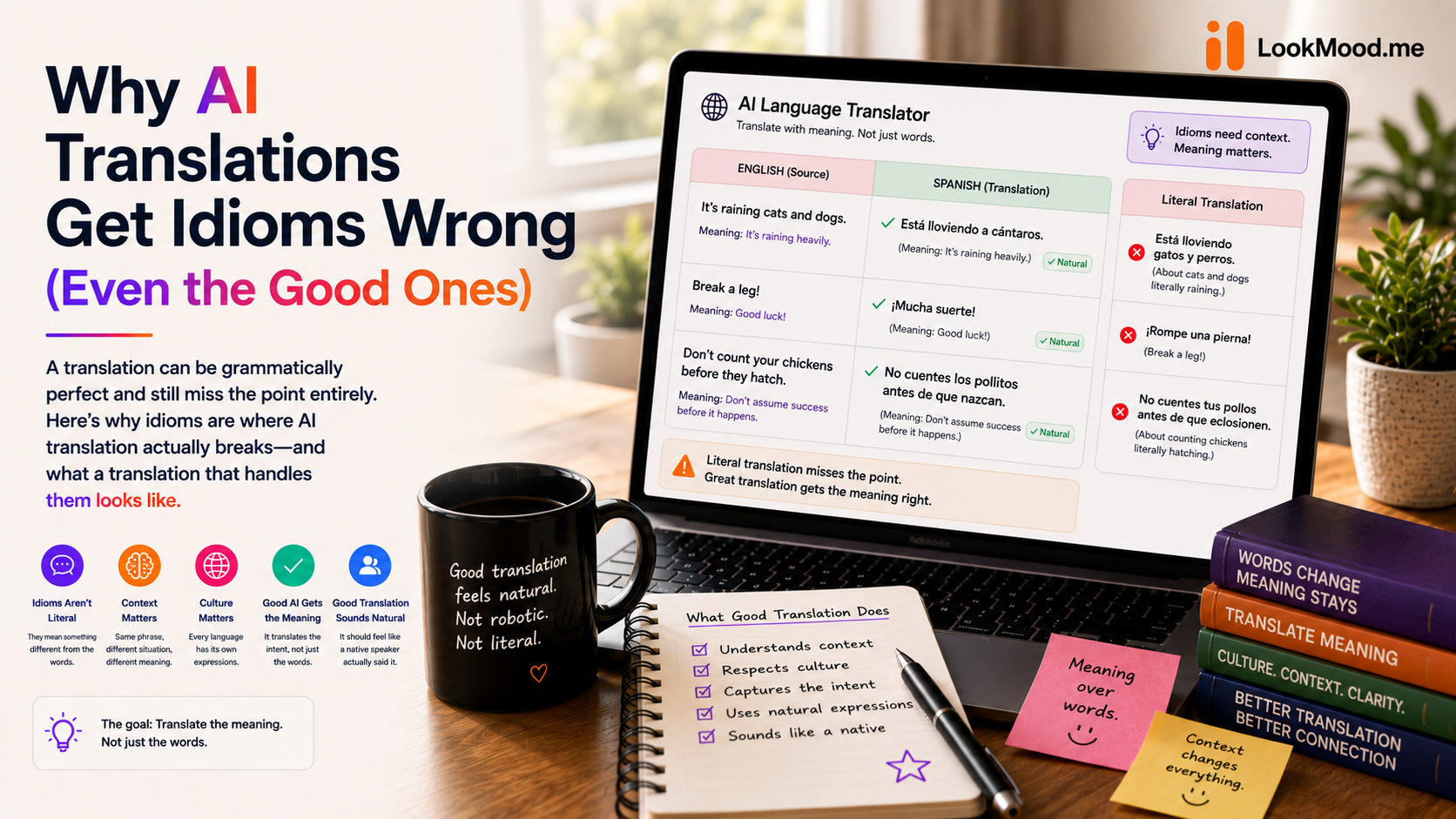
Translate "it's raining cats and dogs" word for word into most languages and you get a sentence about a meteorologically improbable event, not a description of heavy rain. Every language has hundreds of phrases like this — sequences of words that mean something different from what the words literally say — and word-for-word translation is exactly the wrong tool for them.
This is where a lot of AI translation quietly falls apart. Not on vocabulary — modern models are excellent at vocabulary — but on knowing when to translate the meaning instead of the words.
What's actually happening when a translation "sounds off"
A translation that's grammatically correct but reads strangely is usually one of three things:
- A literal idiom. The source phrase isn't meant literally, and the translation kept it literal anyway. The French "il pleut des cordes" ("it's raining ropes") is the rain idiom above, not a comment on rope weather.
- A wrong register. Languages carry formality the way English carries tone — a translation can use technically correct words while sounding far more formal, or far more casual, than the original intended. This matters most in business writing, where the wrong register can read as either stiff or disrespectful.
- A word with no direct equivalent. Some words carry a specific cultural weight that doesn't map cleanly onto any single word in the target language — a good translation has to explain the gap instead of papering over it with the closest available word.
A worked example
The French word "doucement" is a good test case, because it genuinely shifts meaning by context. It can mean gently, slowly, softly, or quietly, depending on what it's describing — a translation tool that just picks one and moves on is guessing, not translating.
A translation that actually handles this tells you which sense applies and why — not just the output word, but the reasoning that got there. That's the difference between a translation you can trust and one you have to independently verify anyway.
What to look for in an AI translator
The honest test isn't "does it get simple sentences right" — every tool does that now. It's whether it explains itself on the sentences where the literal words and the actual meaning diverge. LookMood AI's Language Translator does this by design: alongside the translation, it gives you a short note whenever something doesn't carry over word for word — the same discipline as not citing a source it can't actually confirm — flagging the uncertain part instead of quietly picking an answer and moving on.
It also works from a photo or your camera, not just typed text — point it at a menu or a sign and it reads and translates on the spot, with the same idiom-aware reasoning applied to whatever it finds.
Try it on something that would actually trip up a literal translator
A phrase you already know has some nuance to it — a saying, a piece of slang, something with a double meaning — is the best test of any translation tool, AI or human. Try the Language Translator free, no signup needed, and see whether it catches the part a word-for-word tool would miss.