
Phone-Light Hangover: Why Late Scrolling Feels Like Jet Lag
· LookMood Team
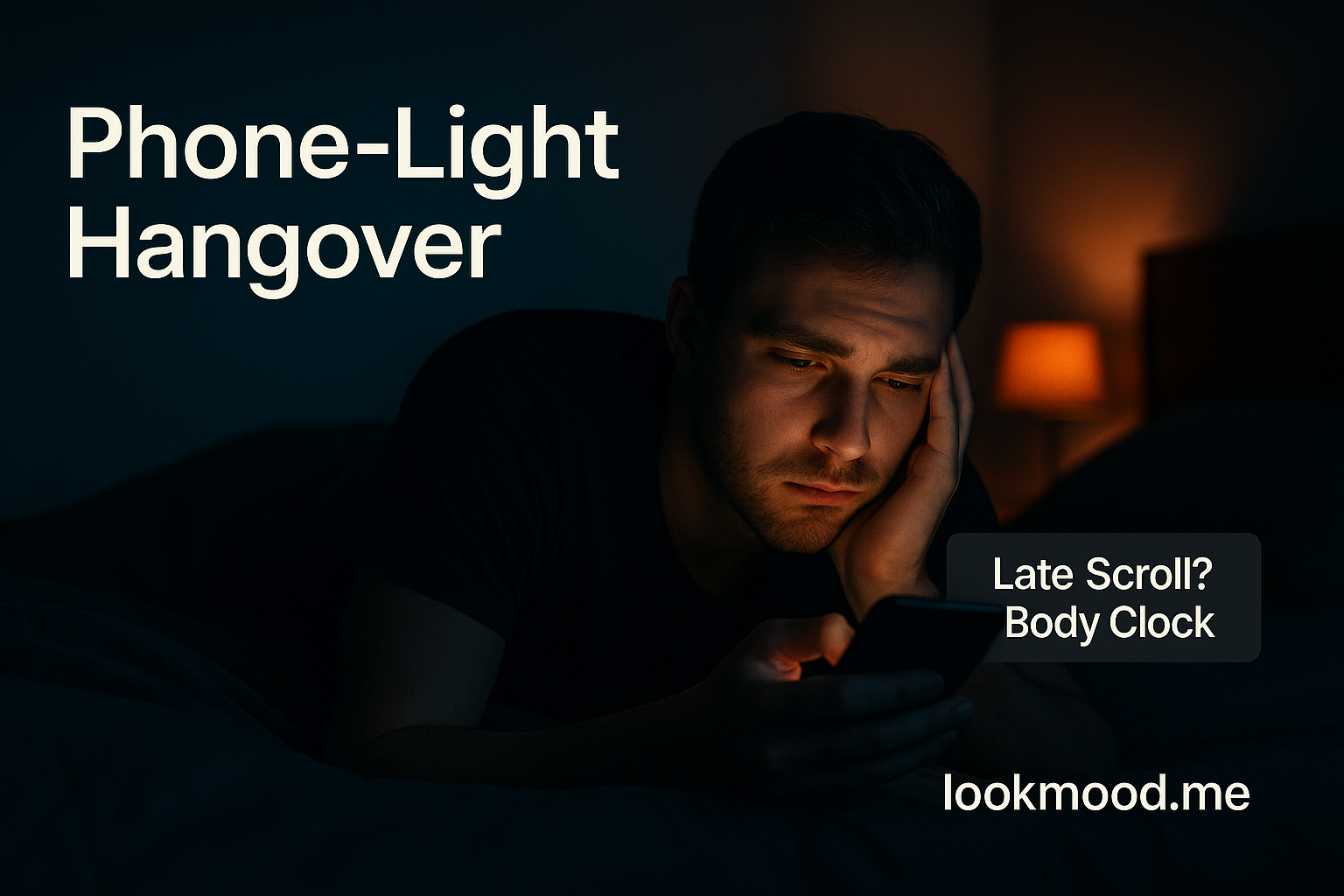
There’s a specific kind of tired that doesn’t feel like simple sleepiness so much as dislocation. You wake with your alarm, upright and vertical, but the rest of you is still arriving from a time zone you never visited. Coffee warms the hands but not the mind. No flights, no hotel keycards, no customs lines—just a phone that stayed bright too late.
We have a name for it now: phone-light hangover. It begins in the small ways we barely register. Ten minutes more to see one last reel. A friend’s message that will surely take thirty seconds to answer. A headline that leads to a second headline; a thread that opens a door to a different argument. Meanwhile, the glow is inches from your eyes, telling a very old clock inside you that the afternoon is not yet over—your circadian rhythm. Knowing the word isn’t the same as noticing how obedient it is to light.
Phone-light hangover: feeling a few beats off your rhythm after late scrolling.
“I didn’t stay up that late,” we say. The body replies: You stayed bright too late.
Why it feels like jet lag (without flying)
Light has always been our master schedule. The body listens to it the way the sea listens to the moon. When light arrives, wake-promoting chemistry cues the day’s orchestra; when light withdraws, a different chemistry ushers in the night. Screens bend that tide. Not because they’re evil—because they are bright and near. The sun is far, your phone is close, and distance matters. At midnight, a palm-sized rectangle becomes a small artificial afternoon.
And it’s not only light. A screen can be dim while the world inside it is still loud. The late-night feed is engineered for frictionless cliffhangers: outrage just gentle enough to keep scrolling, novelty calibrated to almost scratch an itch, humor tuned to reward “one more.” We keep negotiating with sleep in tiny increments, and sleep—like any bartered thing—begins to shrink.
The signals your brain hears at midnight
- Brightness up close → tells your clock the day isn’t done.
- Novelty & outrage loops → keep the mind “on patrol.”
- Micro-bargains (“just 1 more”) → fragments wind-down, lightens sleep.
The result isn’t always insomnia. Often you do sleep; it’s the timing and depth that slip. Imagine going to bed in Mumbai time while telling your brain it’s still Abu Dhabi. You fall asleep, but dreams are brittle and morning arrives before your clock is done setting the table for it. That subtle wrongness—that’s the hangover.
Night modes help—timing still rules
Warm filters and low brightness reduce the hit, but when you stop matters more than how you look at the screen. Treat night mode as a dimmer, not a permission slip.
Key takeaways
- Distance matters: the closer the light, the louder the signal.
- Content matters: quiet UI ≠ quiet brain.
- Consistency wins: small, repeatable buffers beat heroic detoxes.
The 60 / 30 / 10 wind-down (realistic, repeatable)
- 60 minutes before sleep (best case): screens off. Do something slow and finite—paper pages, a short walk in low light, three lines in a notebook.
- 30 minutes if you can’t do 60: one batched check, ultra-dim + warm, standing up so the bed stays a border. No rabbit holes.
- Last 10 minutes: no screens at all. Let the lamp go dark and let your breath set the metronome.
“Go to bed earlier” is a blunt instrument. Give yourself darkness and something quiet to do—that’s a key you can actually turn.
Portals should close. Maps should fold up.
This isn’t moralizing about phones. They are our portal and our workplace, our entertainment and our map. But portals should close, and maps should fold up. What we are protecting is not “discipline” in the gym-poster sense; we are protecting the pace at which our biology knows how to be a person. The day is for input. The night is for stitching that input into memory and sense. Keep the needle moving too late and the stitching frays.
Some nights won’t be clean—babies cry; deadlines slide; worry sits upright and wants to talk. When that happens, repair is simple and ancient. Morning light, even cloudy, is a lever. Step outside or stand by a window. Two minutes of movement convinces a reluctant brain the day has started. Water because we mistake thirst for a dozen other feelings. Food, not a feast; protein over sugar. These aren’t heroics; they’re small bribes paid to physiology to come back to you.
Morning repair kit (for last night’s mistake)
- Light early: outdoors or bright window within an hour of waking.
- Move 5–10 minutes: walk, mobility, chores—anything that raises pulse slightly.
- Hydrate + protein: steadier energy beats sugar spikes.
- Delay caffeine 60–90 min: smoother curve, fewer crashes.
- Keep wake time fixed: it anchors the clock you unmoored.
The tiny ritual that survives bad days
Keep a wind-down you can’t fail: one page of a book, three journal lines, or a 30-second voice note to future-you—Here’s what bothered me; here’s what I’ll try tomorrow. The ritual isn’t for productivity metrics. It’s for telling your nervous system the episode has ended; no new characters will be introduced; the credits can roll.
Late scrolling is often mercy, not weakness—a private after-party for a day that asked too much. Keep the after-party. Make it shorter. Move it earlier. Dim the music.
If you wake a little displaced, don’t invent a failing. You’re not broken; you’re jet-lagged by a sun you held in your hand. Step into the actual one. Let it do what it’s been doing for every creature with eyes long before apps and alarms and infinite feeds. The light arrives. The orchestra tunes. You come back into time with yourself.