
How to Read Your Own Mood — Without an App
· LookMood Team
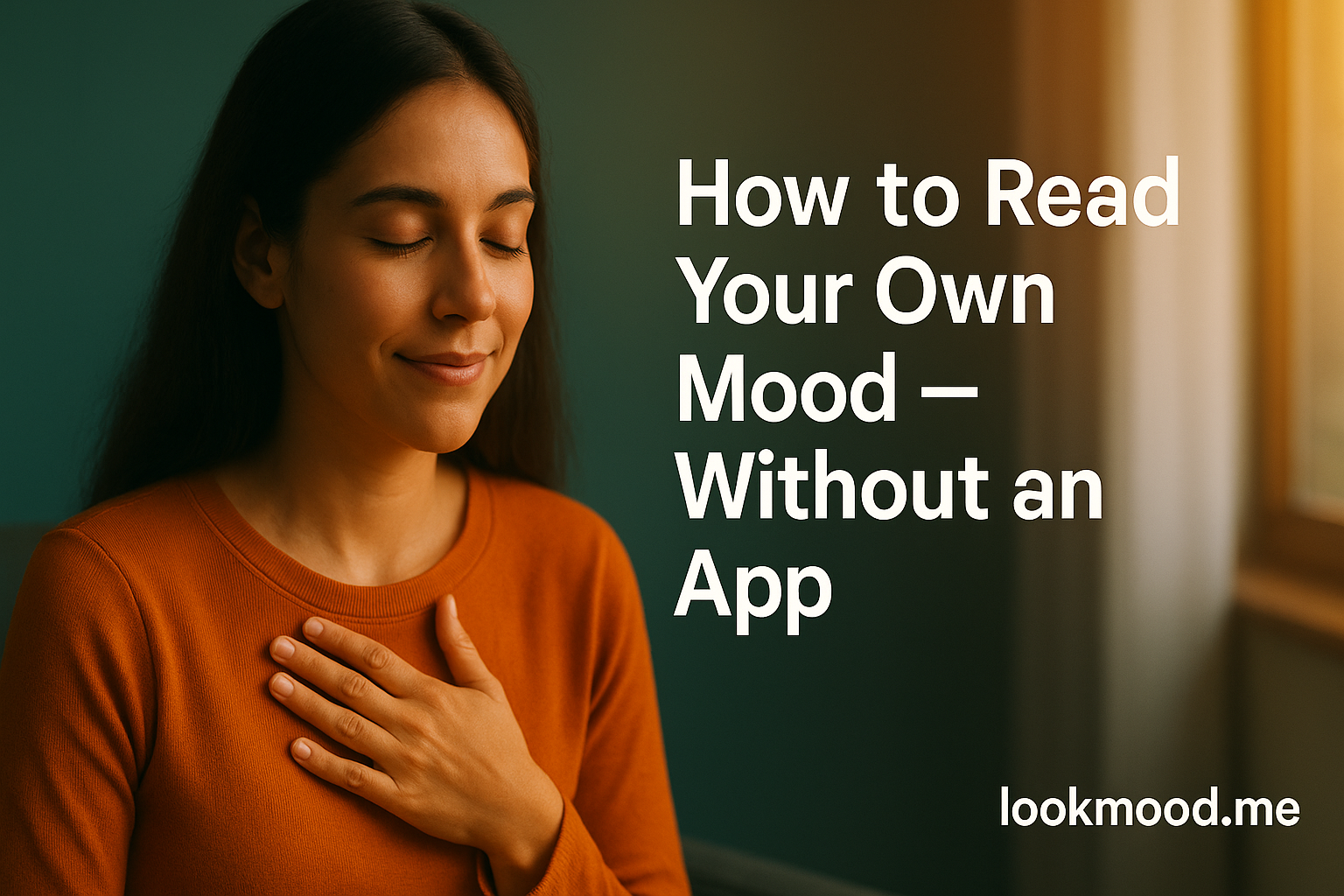
You don’t need a camera or algorithm to sense what’s happening inside you. Every emotion leaves a trail — in your breathing, your muscles, even the rhythm of your thoughts. The trick is learning to read it before the world does.
“Mood isn’t random — it’s information. When you learn to read it, you understand yourself in real time.”
1. Start with the body, not the mind
Your body is the first to notice a mood shift. Before you feel “sad” or “angry,” your breathing, posture, and micro-movements change. These physical cues are ancient survival systems — quick, honest, and hard to fake.
- Shoulders forward? Your body may be protecting itself, signaling withdrawal or stress.
- Fast heartbeat or shallow breath? Your system might be preparing for action — not always fear, sometimes focus.
- Loose jaw and soft gaze? That’s relaxation in progress, not laziness.
Before labeling emotions, notice the data your body gives. It’s the most honest analytics dashboard you’ll ever have.
2. Track your “energy language”
Mood isn’t just about happy or sad — it’s energy moving through you. Some days it’s high and restless, other days slow and reflective. By identifying your personal energy signature, you start predicting your own emotional patterns.
- High energy + tension: often shows up as frustration or anxiety.
- High energy + openness: creativity, confidence, excitement.
- Low energy + heaviness: sadness or depletion.
- Low energy + calm: peace, contentment, focus.
The goal isn’t to control energy — it’s to cooperate with it. You can’t surf every wave, but you can learn which tide you’re in.
3. Ask “What story is my mood telling me?”
Every emotion carries a message. Anger protects boundaries, sadness demands rest, joy signals alignment. Instead of trying to “fix” a mood, listen for the story underneath.
Try journaling or even voice-noting your state. When you describe your mood out loud, your brain shifts from emotion to observation — a process psychologists call affect labeling. It lowers stress and boosts emotional intelligence.
4. Compare inner cues with outer reflection
Once you’re tuned into your body, mirrors and apps become allies, not crutches. Tools like LookMood amplify what you already sense, translating facial micro-expressions and voice tone into visual feedback. Seeing your emotion externally can confirm what you feel internally — or reveal something you missed.
But the power still begins with you. The most accurate sensor is self-awareness.
5. Practice emotional neutrality
Reading your mood doesn’t mean judging it. Neutral observation is where clarity lives. When you stop labeling emotions as “good” or “bad,” they move faster through your system. What remains is insight — not overreaction.
Emotions are waves; awareness is the shore. The goal isn’t to stop waves, but to stand steadily as they arrive.
When technology joins intuition
AI is now catching up to what your nervous system has done for millennia. LookMood’s Core OS and MoodPlay don’t replace awareness — they reflect it. The camera or microphone becomes a mirror for the feelings you’ve learned to notice.
The future of Emotion Tech isn’t cold analysis; it’s deeper empathy. Machines can help us notice, but understanding still begins with the human behind the lens.
You don’t always need data to understand your state — you just need curiosity. Because when you start listening to your own signals, you realize that your body and mind have been speaking the same language all along.