
How to Actually Plan a Piece of Content With AI (Idea → Hook → Caption → Hashtags)
· LookMood AI
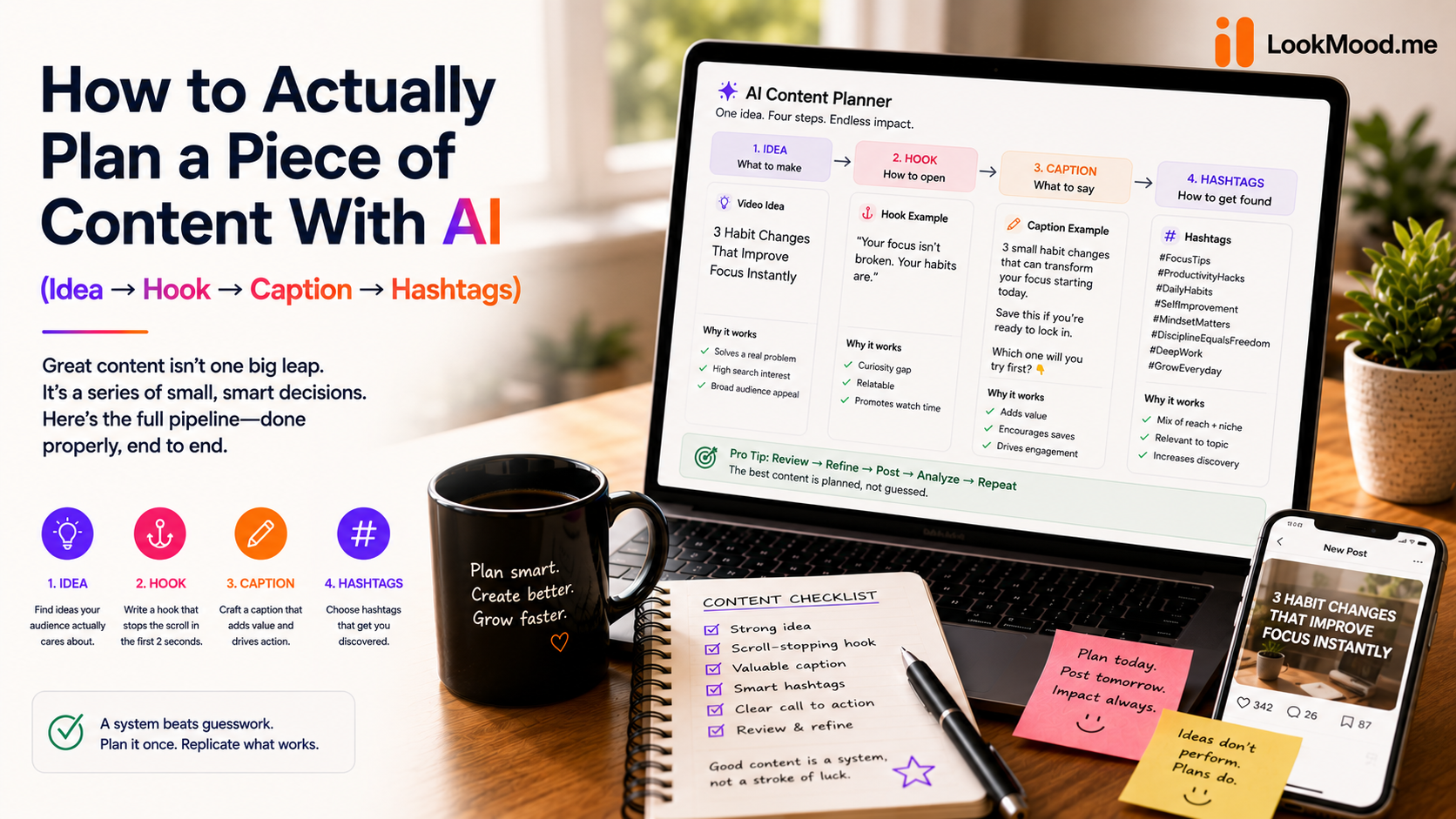
Posting something that actually works isn't one decision — it's four: what to make, how to open it, what to say underneath it, and how it gets found. Most people solve each of these with a different generic tool, or skip straight to writing without really deciding any of them, which is why so much content quietly underperforms without anyone being able to say exactly why.
Laid out as a pipeline, each step has a specific, common failure mode — and each one is fixable on its own.
1. The idea — where "just brainstorm" usually fails
A topic isn't an idea. "A video about home organization" is a subject; "ranking every organizing hack I tried by how fast I gave up on it" is an idea, because it has a specific angle that gives someone a reason to watch this one. Most idea generators — and most people's own brainstorming — stop at the topic, because the angle that would actually be interesting is usually the thing you're too close to your own niche to notice.
Why most "content ideas" are just your topic restated covers this in full — the short version is that a real idea needs a specific frame, not a subject.
2. The hook — where one option is really a guess
The opening line decides whether anyone sees the rest of the video, and it works through one of a few real mechanisms — curiosity, a bold claim, relatability, a pattern interrupt. Writing one hook and shipping it means betting on a mechanism you haven't tested against any alternative.
Why you need three hooks, not one goes into what genuinely different options look like, versus three sentences that are secretly the same idea worded three ways.
3. The caption — where one version is trying to serve every platform
The words underneath the hook need to match the platform's actual register — LinkedIn rewards professional, Instagram rewards voice, TikTok rewards brevity. A caption smoothed into something that could work anywhere usually ends up excelling nowhere.
Why the same caption doesn't work on Instagram and LinkedIn covers what actually changes between platforms and why.
4. The hashtags — where a flat list stands in for a real strategy
Discovery isn't one decision either — a real hashtag mix uses a couple of broad, high-reach tags alongside several niche tags that reach a smaller but genuinely interested audience, plus a branded tag only when there's an actual brand to tie it to. A flat list of ten similarly-sized tags isn't a strategy, it's a guess repeated ten times.
Why a flat list of hashtags doesn't work covers the tiered approach in full.
Running the whole pipeline
Each of these is a genuinely separate decision, but they're meant to happen in sequence, against the same piece of content:
- Video Idea Generator — describe your niche or a rough topic (or ask it to surprise you), get specific angles with the reasoning behind each one.
- Hook Generator — take the idea you picked, get three genuinely different opening lines built on different attention mechanisms.
- Caption Generator — write the caption for the specific platform you're posting to, not a generic version.
- Hashtag Generator — get a tiered mix of broad, niche, and branded tags, sized for the platform.
Same agent, same conversation, the whole way through — no switching between four separate single-purpose tools and losing context between each one.
Start with the idea
Every piece of content starts as a rough thought before it's anything else. Begin with the Video Idea Generator — free, no signup needed — and work through the pipeline from there.